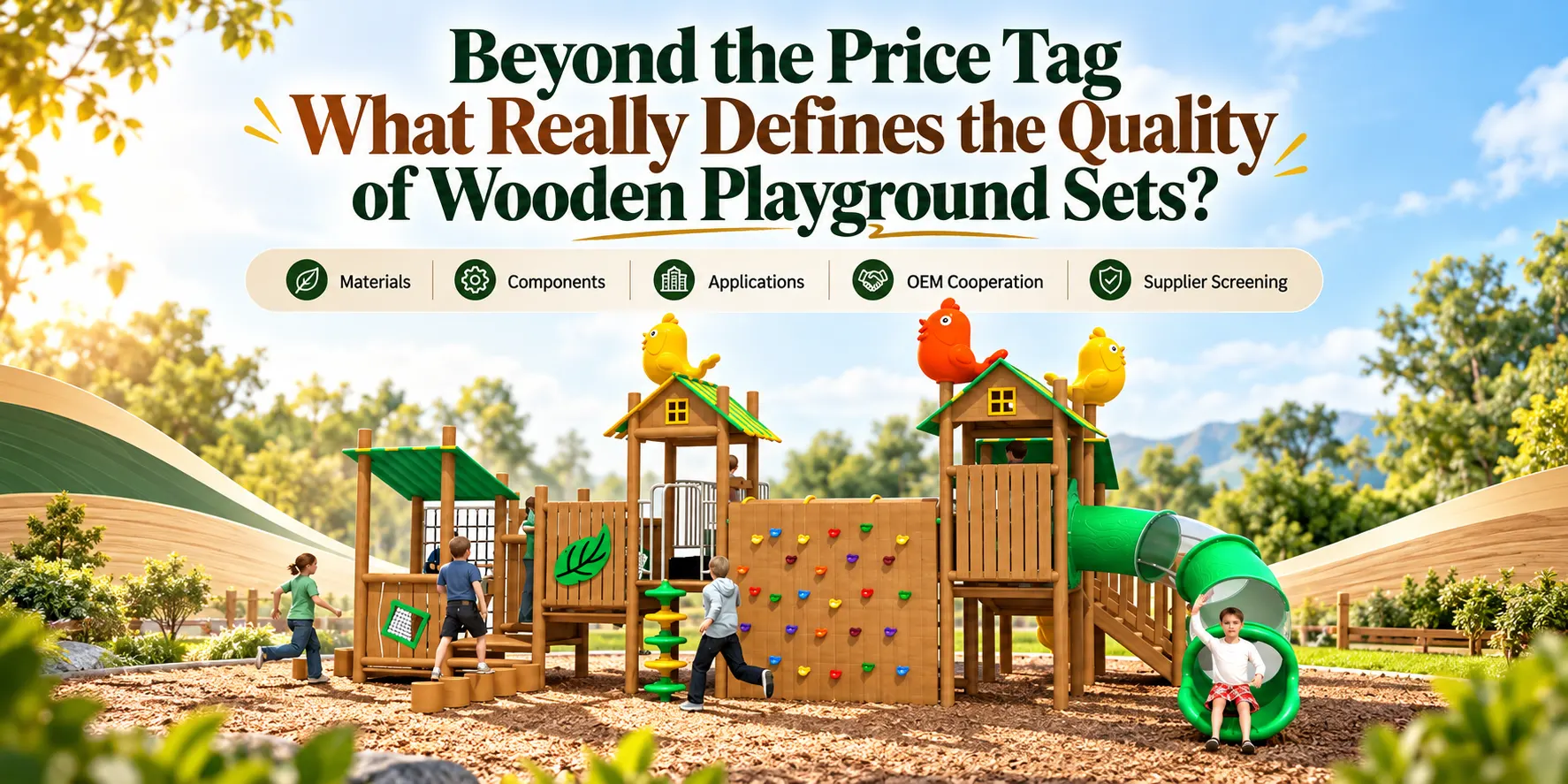
You are sourcing wooden playground sets for a kindergarten, holiday park, or housing scheme. Two quotes for the same 110 mm square post can sit 30% apart, and the difference rarely shows in photos. It hides in timber grade, bracket thickness, fixing counts, and inspection records. Buyers comparing Wenzhou playground equipment with other supply bases run into the same question: what is actually in the crate? This guide covers build steps, component types, applications, and supplier screening.
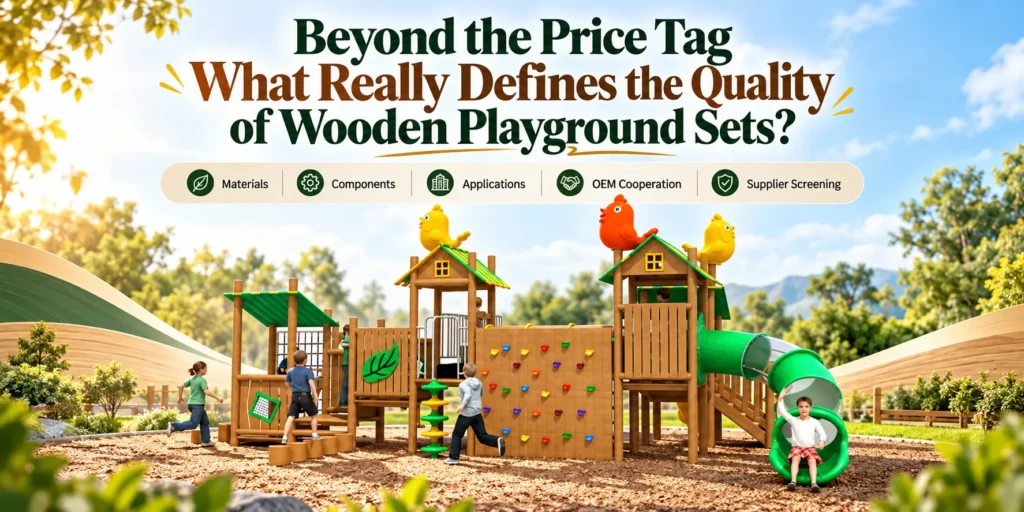
Wooden playground sets are modular outdoor play structures built from treated timber posts, platforms, decks, and rails, fitted with accessories such as slides, swings, climbing walls, and roofs. The main frame carries the load; galvanised or stainless-steel brackets, bolts, and anchors join the parts. Timber is usually pressure-treated pine, cedar, or robinia, chosen for rot resistance and splinter-free surfaces. Sets are specified by post size, platform height, deck area, age group, and safety clearance, and are installed on grass, rubber surfacing, or sand.
First, how a set goes together decides which specifications you can verify with a supplier.
How Wooden Playground Sets Work
A wooden set works as a load path: posts carry the frame, brackets transfer movement into the ground, and anchors keep the structure still. Four checks matter before you approve a specification.
- Site and age band. Match deck height and fall zone to the user group — usually 2–5 or 5–12 years — before fixing dimensions.
- Frame assembly. Posts, beams and braces join with bolts or metal brackets; timber grade and section size set the stiffness.
- Play modules. Slides, swings and climbing panels bolt to the same frame, so module weight drives post spacing.
- Ground fixing. Anchors, footings or sleeves resist rocking, and surfacing depth follows fall height.
Component roles
Posts and beams take the load, connectors take the stress, and platforms set the play level. A fastener schedule plus an assembly drawing are what make batches repeatable. Those parts define the product families you compare next.
Wooden Playground Sets Components and Product Types
Four families cover most orders: swing frames, play towers, climbing frames and timber playhouses. Compare post size, deck height and hardware before you send an RFQ.
| Product type | Core components | Age band | Check first |
|---|---|---|---|
| Swing frame | 90 × 90 mm posts, A-frame brackets, hangers | 3–12 | Post diameter vs span |
| Play tower | Posts, platforms, guard rails, slide chute | 3–10 | Deck height and spacing |
| Climbing frame | Ladders, holds, cargo nets, beam clamps | 5–12 | Rung spacing, grip diameter |
| Playhouse / sandpit | Panel and roof kits, floor boards | 2–8 | Panel thickness, edge finish |
- Timber grade: cedar and pine dominate; specify moisture content and knot limits.
- Fasteners: galvanised or stainless bolts plus ground anchors; coastal sites change the corrosion spec.
- Accessory packs: slides and nets — confirm HDPE or PP and colour options per batch.
- Packing format: hardware bagged per set rather than bulk cuts site assembly time.
Site type narrows the choice further — a nursery courtyard and a resort garden rarely take the same frame.
Typical Applications for Wooden Playground Sets
Application decides the frame before price does. A nursery courtyard and a holiday-park deck rarely take the same tower.
- Early years and schools: compact towers with platform heights between 600 mm and 1,200 mm, no finger-trap gaps of 8–25 mm, and batches of 20–30 units per site.
- Resorts and hospitality: mixed indoor-outdoor layouts, sometimes combined with PE board playground equipment where poolside panels must resist splintering and repeated cleaning.
- Parks and housing schemes: repeat volumes of 50+ units, so ask for batch inspection records, connector and fixing samples, and per-post load evidence before you confirm.
Once application, quantity and evidence lines are agreed, the build turns to custom manufacturing and OEM cooperation.
Custom Wooden Playground Sets Manufacturing and OEM Cooperation
Custom wooden playground sets are built on document control, not verbal promises. Buyers specifying kindergarten playground equipment often need non-standard platform heights or swing bay widths, so the first useful step is a feasibility check rather than a price.
| Stage | Buyer input | Manufacturer output |
|---|---|---|
| Drawing or sample | Dimensioned drawing, 3D file or physical sample; platform height, slide length, bay count | Feasibility note, timber and hardware list, indicative quote |
| Sample confirmation | Finish colour, logo placement, packaging mock-up | Sealed pre-production sample with material record |
| Packaging | Carton labels, barcode, pallet pattern, loading limits | Carton artwork proof, flat-pack layout, loading plan |
| Batch inspection | Agreed checkpoints, evidence type, batch coding | Inspection report with batch code and packing photos |
| Shipment | Delivery window, port, document set | Booked shipment, packing list, loading photos |
OEM cooperation adds private-label cartons, printed play panels and colour matching to a supplied sample. Inspection usually covers timber moisture, sanded edges, bolt-hole alignment and hardware counts. Fix those criteria before cutting starts, then compare supplier types by capacity for your volume.
Top 10 Wooden Playground Sets Manufacturers and Supplier Fit
Supplier type matters more than brand name here. European playset makers lead on certified swing and climbing systems, while Asian OEM factories lead on custom sizes, colours and private-label packing. Match your sales channel to those strengths. Ask for playground equipment specifications before discussing price, because timber grade, hardware metal and test files vary sharply between these four groups.
| Supplier type | Pros | Cons | Best fit |
|---|---|---|---|
| European playset brands | EN 1176 test files; cedar and redwood; modular add-ons | Long lead times; high unit cost; limited colour changes | Premium retail resale, school tenders |
| OEM wood factories | Custom dimensions; own-brand cartons; flexible hardware | Samples take 15–25 days; audit quality varies | Distributors building their own range |
| Indoor/soft play specialists | Padded platforms; indoor panel systems | Weaker outdoor timber seasoning experience | Kindergartens, indoor play centres |
| PE board and flat-pack makers | Fast container volume; low unit price | Fewer certified swing and climbing sets | Budget outdoor ranges, high volume |
Scoring checklist before you shortlist:
- Chain-of-custody paperwork for the timber species.
- One EN 1176 or ASTM F1487 report per model, not per factory.
- Timber moisture recorded at 12–15%.
- Galvanised or stainless fixings, counted against the parts list.
- Container packing plan with unit and carton counts.
Shortlist the supplier whose weakest evidence you can defend to your own customer, not the one with the cheapest quote.
About JQ Playground – wenzhouplaygroundequipment.com
JQ Playground (Wenzhou Jiqi Amusement Equipment Co., Ltd.) is a children’s playground equipment manufacturer founded in 1993. The company provides design, customization, large-scale manufacturing, sales, installation guidance, and after-sales support for outdoor playgrounds, indoor playgrounds, soft play, water playgrounds, PE board playgrounds, kindergarten furniture, outdoor fitness equipment, pet playgrounds, and playground facilities. Approved company facts include 180+ employees, a large Wenzhou production base, 20+ production lines, 55 production machines, ISO/BSCI/EN1176/EN71/ASTM/CPC/CPSIC certification references, 100+ patents, free design support, OEM/ODM capability, trial installation before shipping, export experience, and one-year quality warranty.