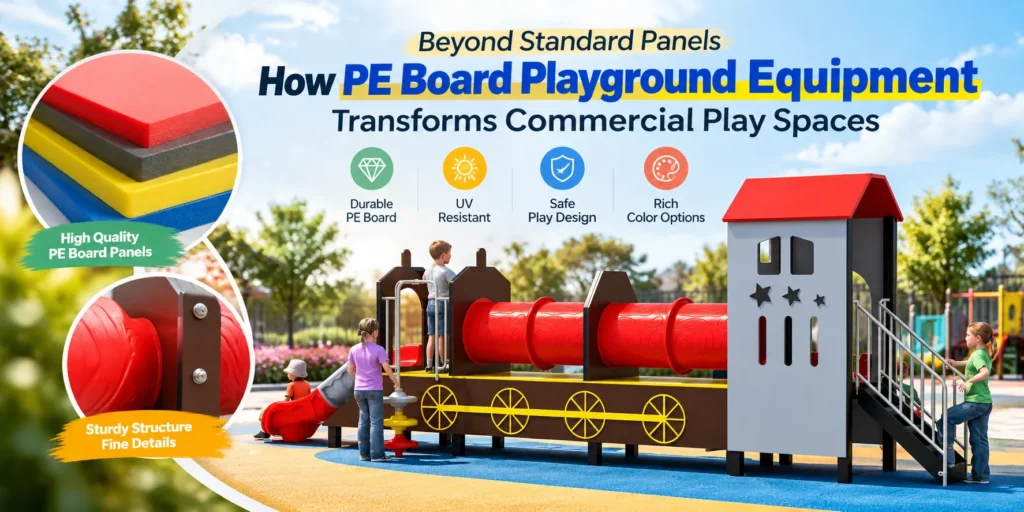
You are assembling a playground package and comparing supplier catalogues. Then PE board panels appear in different thicknesses, colours and price bands, with little on the page to help you judge like for like.
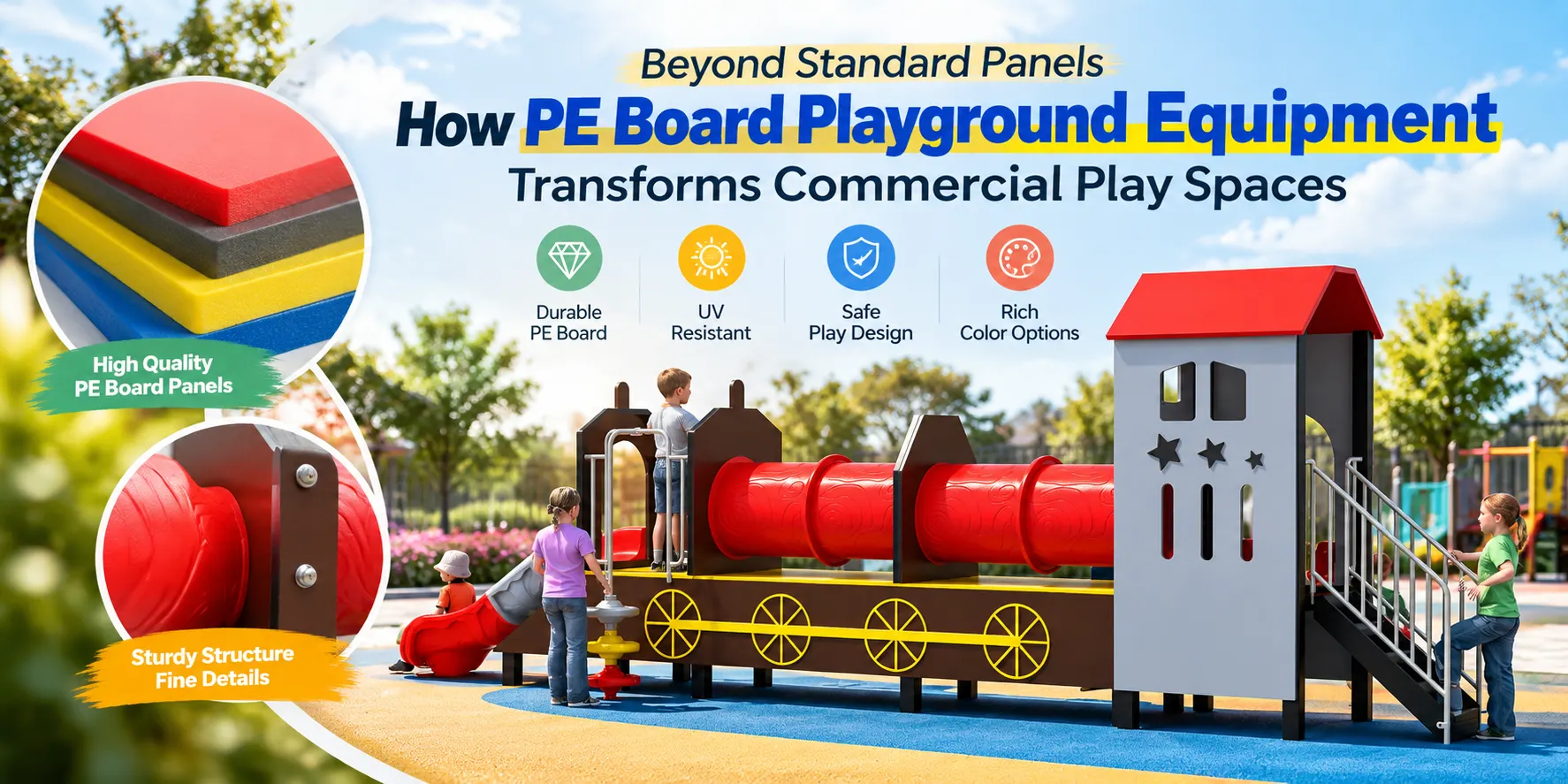
PE board playground equipment refers to high-density polyethylene panel systems used for play panels, climbers, slides and modular towers in commercial and institutional play areas.
The sections below cover panel specifications, product categories, site applications and factory sourcing checks.
PE Board Panels Explained: Thickness, Density and Outdoor Weather Performance
PE board in playground construction is extruded HDPE sheet at 0.94–0.96 g/cm³, or a recycled composite blending HDPE with wood flour or mineral filler at 0.95–1.10 g/cm³. Structural panels — tower infill, climbing faces, slide sides — usually run 18–25 mm; decorative and graphic panels run 10–12 mm. Spec sheets should state thickness tolerance (often ±0.3 mm), density to ISO 1183, and UV additive loading by percentage, not just “UV-stabilised” in marketing copy.
HDPE absorbs under 0.01% water (ISO 62), so panels do not swell like a plywood core (8–12% thickness swell) or delaminate like MDF. Colour fade is the real exposure risk: suppliers quote 2–3% carbon black or a HALS package backed by xenon-arc data to ISO 4892-2. Ask to see the extrusion lot report, the UV masterbatch datasheet naming the stabiliser and its loading, and the weathering report with test hours and ΔE value. Cut edges need a 3–6 mm radius, and fixings at 200–250 mm centres with M6–M8 stainless fasteners plus 2–3 mm per metre expansion gaps.
| Panel thickness | Typical use | Frame fit |
|---|---|---|
| 10–12 mm | Themed and graphic panels, decorative infill | 45 mm timber batten or 1.5–2 mm steel, M6 |
| 15–18 mm | Activity play panels, slide surrounds | 40×40 mm steel or 45 mm timber, M6–M8 |
| 20–25 mm | Structural tower infill, climbing faces | 50×50 mm steel, M8 through-bolt |
PE Board Playground Equipment Categories: Play Panels, Climbers, Slides and Modular Towers
Commercial supplier menus typically sort PE board playground equipment by play function first — panels, climbers, slides, towers — then list PE board as a sub-material inside each range. Buyers shortlist by activity and age band before sheet spec, so mirror that order on a quote-ready page.
- Activity and learning play panels (ages 2–5, 5–12): quote by panel count; show insert options, fixing centres and age label.
- Climbing walls and angled climbers (ages 5–12): PE board faces over steel; publish wall angle, hold spacing and fall height.
- Slide sides and surrounds (ages 2–5, 5–12): pair surrounds with platform height and entry width so slide sets compare like for like.
- Modular towers and deck systems (ages 3–12): list footprint, deck height and connector count per module; PE board is the infill line.
- Themed and shaped panel sets (ages 2–8): quote by shape template; show colour options, mounting pattern and replacement panel price.
Site setting then decides the final panel specification.
Where Are PE Board Play Structures Specified in Schools, Parks and Indoor Play Zones?
Panel gauge, edge radius and fixing method follow three things: site type, age band and play surface. The four settings below cover most purchase briefs.
School Yards and Kindergarten Outdoor Areas
Ages 3–6 dominate. Cap panel height near 900 mm so staff sightlines stay clear across the yard.
Public Parks and Community Play Spaces
Ages 5–12, taller towers. Allow 1.5–2 m of fall-zone clearance past each deck edge and specify in-ground posts.
Residential Compounds and HOA Play Areas
Tighter footprints suit surface-mounted posts, which also retrofit onto existing slabs without excavation.
Indoor Play Zones
Air-conditioning lowers humidity, yet glazing still admits UV. Ask for stabiliser content in writing on PE board playground equipment, not a ‘UV resistant’ label.
Outdoor sites usually justify a higher stabiliser loading than shaded indoor halls; state the exposure level on the RFQ.
Custom Builds and Supplier Checks: Sourcing PE Board Play Sets from Wenzhou Factories
Once exposure level is agreed, the next question is how far a factory will cut to your drawing rather than ship stock sizes. Themed shapes, colour-matched graphics, logo or curriculum panels, and modular bays that bolt onto standard towers are all routine briefs; a kindergarten playground equipment order can pair the play set with matching furniture in one container.
The sequence is drawing approval, panel cutting and edge radiusing, hardware matching, pre-packing, then a loading plan. Request the drawing marked up with thickness and fixings before cutting starts.
Extract these before ordering:
– ASTM F1487 or EN1176 clause references the design is checked against.
– Third-party test reports naming the panel type and test date.
– MOQ and lead time split by panel type: plain, printed, shaped.
– Packing method plus container loading plan in cubic metres.
– RFQ detail: panel sizes, colours, artwork files, quantity, sample expectations.
About JQ Playground – wenzhouplaygroundequipment.com
JQ Playground (Wenzhou Jiqi Amusement Equipment Co., Ltd.) is a children’s playground equipment manufacturer founded in 1993. The company provides design, customization, large-scale manufacturing, sales, installation guidance, and after-sales support for outdoor playgrounds, indoor playgrounds, soft play, water playgrounds, PE board playgrounds, kindergarten furniture, outdoor fitness equipment, pet playgrounds, and playground facilities. Approved company facts include 180+ employees, a large Wenzhou production base, 20+ production lines, 55 production machines, ISO/BSCI/EN1176/EN71/ASTM/CPC/CPSIC certification references, 100+ patents, free design support, OEM/ODM capability, trial installation before shipping, export experience, and one-year quality warranty.