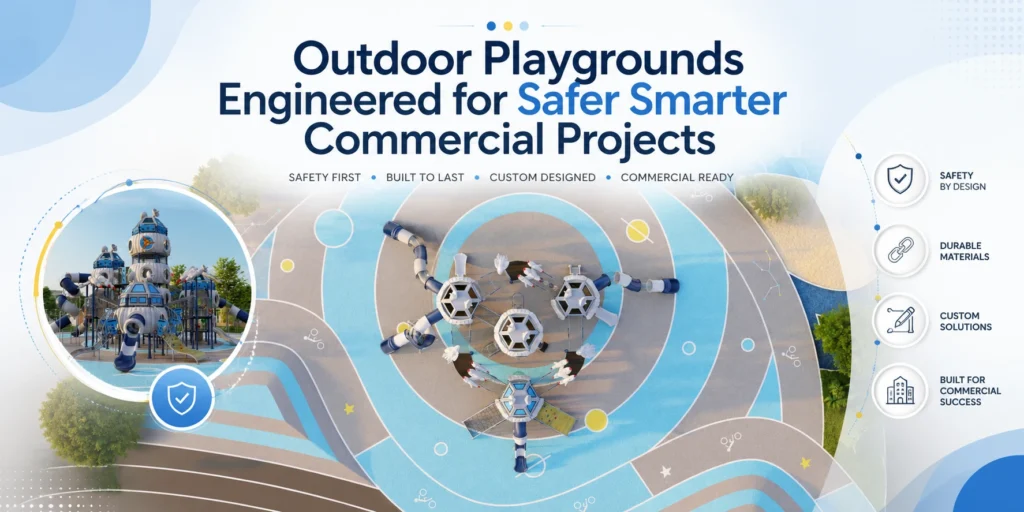
When planning a commercial playground project, you need equipment that balances durability, safety, and play value. Choosing the wrong structure can lead to costly replacements or compliance issues. You must also account for age ranges, impact surfacing, and vandal resistance while staying within budget. The variety of suppliers—including those offering playground equipment Wenzhou—adds to the complexity.
Outdoor playgrounds are structured play areas designed for open-air environments, featuring equipment like swings, slides, climbers, and multi-activity units.
This guide covers key equipment types, materials, safety standards, customization options, and sourcing factors to help buyers make informed decisions.
Types of Outdoor Playground Equipment for Commercial Use
Commercial playgrounds rely on six core equipment categories. Each serves different age groups and settings. Swings suit parks and preschools: toddler bucket swings (ages 1–3) provide full back support, while belt swings (ages 5–12) handle higher dynamic loads. Slides range from 1.2 m low drop models for toddlers to 3 m spiral slides for school-age children. Climbers include small arched ladders for ages 2–5 and net climbers or rock walls for ages 5–12. Multi-play structures combine slides, bridges, and tunnels in one footprint, ideal for resort play areas where space is limited. Spinners (bowl spinners, merry-go-rounds) appeal to all ages, but centrifugal-force models need minimum 4 m clearance zones. Balance equipment like beam sets and stepping logs develop motor skills; choose low heights (under 50 cm) for toddlers.
Two trends now drive specification. Inclusive play adds transfer platforms, sensory panels, and wheelchair-accessible ramps — a requirement for many public park RFQs in 2025. Nature-themed designs replace primary colours with wood-grain textures, green roofs, and log-shaped climbers, meeting growing demand from eco-resorts and school playgrounds. When sourcing commercial playground equipment from Wenzhou, verify that each category has age-specific dimensions and fall-height ratings to match your site plan.
Key Material and Safety Standards for Outdoor Playgrounds
Material selection directly affects equipment lifespan, maintenance costs, and compliance with international safety standards. Four materials dominate commercial outdoor projects: rotomoulded PE board, galvanised steel, aluminium, and wood.
- Rotomoulded PE board offers excellent UV resistance (typically rated for 2000-hour Xenon-arc exposure) and colour retention. It resists rust and splintering, but can become brittle in extreme cold below -20°C.
- Galvanised steel provides structural strength with a zinc coating thickness of at least 85µm per ASTM A123. It supports heavy climbing frames but requires regular inspection for coating wear near coastal environments.
- Aluminium is lightweight and corrosion-resistant without painting, ideal for inclusive play structures with integrated ramps. Its heat conductivity can cause surface temperatures above 60°C in direct sun—specify powder coating to mitigate this.
- Wood (pressure-treated pine or cedar) offers natural aesthetics for nature-themed parks. Requires annual sealing and replacement of softwood components every 3–5 years due to rot susceptibility.
Critical certifications for commercial procurement:
– ASTM F1487 (US) and EN1176 (EU) specify impact attenuation, entrapment clearances, and structural load requirements.
– CE marking confirms conformity with EU safety directives.
– AS 4685 (Australia) adds specific drop-height zones for timber structures.
Compliance is not optional for commercial liability. Insurers and local authorities increasingly mandate third-party test reports per these standards before approving installation. When sourcing equipment, request the current test certificate version—some factories offer EN1176-1:2017 compliant components that meet UK and EU import requirements.
Customization and Design Options for Outdoor Playgrounds
A standard catalogue rarely matches your site constraints or brand identity. Customisation lets you align equipment dimensions, theme, and surfacing with your project’s footprint, capacity target, and safety zone requirements. Factories typically offer modular components—posts, decks, panels—that can be rearranged without tooling new moulds, reducing both cost and lead time.
Theme options range from castle turrets and pirate ships to space stations and nature-inspired configurations. Colour schemes are specified by RAL or Pantone codes; high-contrast combinations (e.g., yellow on blue) improve visual appeal and child-wayfinding. When designing, you must specify:
- Site dimensions and fall zones – measure the clear area plus 1.8 m clearance on all sides. For example, a 6 m-high slide requires a 10 m unencumbered zone in the slide direction.
- Capacity and user age – define simultaneous users (e.g., 30 children aged 3–6) to size decks and entry/exit points.
- Surfacing type and thickness – engineered wood fibre absorbs falls up to 3 m at 300 mm depth; rubber tiles offer 2.5 m critical fall height with less maintenance. Both meet EN1176 impact attenuation requirements.
- Accessibility features – include ramps, transfer platforms, and ground-level play elements to comply with inclusivity standards.
Many suppliers provide free 3D renderings using design software (SolidWorks or AutoCAD-based tools) once you submit a scaled site plan. For water playground equipment suppliers, theme and colour customisation extends to splash pads and spray features. If you require PE board playground equipment, confirm the factory can match your colour and texture specifications via rotomoulding or injection-moulded PE panels. Request a rendered layout before committing to production.
Factors to Evaluate When Sourcing Outdoor Playground Equipment from Chinese Factories
When you evaluate Chinese factories for kindergarten playground equipment or general playground facility equipment, prioritise quality assurance over price. Request factory audit reports (ISO 9001 or equivalent) and arrange sample testing before bulk production. Lead times typically range from 30 to 60 days, depending on order complexity and season. For shipping, compare FOB (factory to port) vs CIF (insurance and freight included) to control total landed cost. Minimum order quantities often start at 20–50 sets, but confirm before negotiating. Before committing, demand these documents: detailed specification sheets, third-party test reports (e.g., EN1176 or ASTM F1487), and a full installation manual. Avoid the lowest-price bias — inspect build quality such as galvanised steel thickness (minimum 2 mm) and UV-stabilised PE board density. A marginally higher upfront cost usually reduces maintenance and replacement expenses over five years.
About JQ Playground – wenzhouplaygroundequipment.com
JQ Playground (Wenzhou Jiqi Amusement Equipment Co., Ltd.) is a children’s playground equipment manufacturer founded in 1993. The company provides design, customization, large-scale manufacturing, sales, installation guidance, and after-sales support for outdoor playgrounds, indoor playgrounds, soft play, water playgrounds, PE board playgrounds, kindergarten furniture, outdoor fitness equipment, pet playgrounds, and playground facilities. Approved company facts include 180+ employees, a large Wenzhou production base, 20+ production lines, 55 production machines, ISO/BSCI/EN1176/EN71/ASTM/CPC/CPSIC certification references, 100+ patents, free design support, OEM/ODM capability, trial installation before shipping, export experience, and one-year quality warranty.