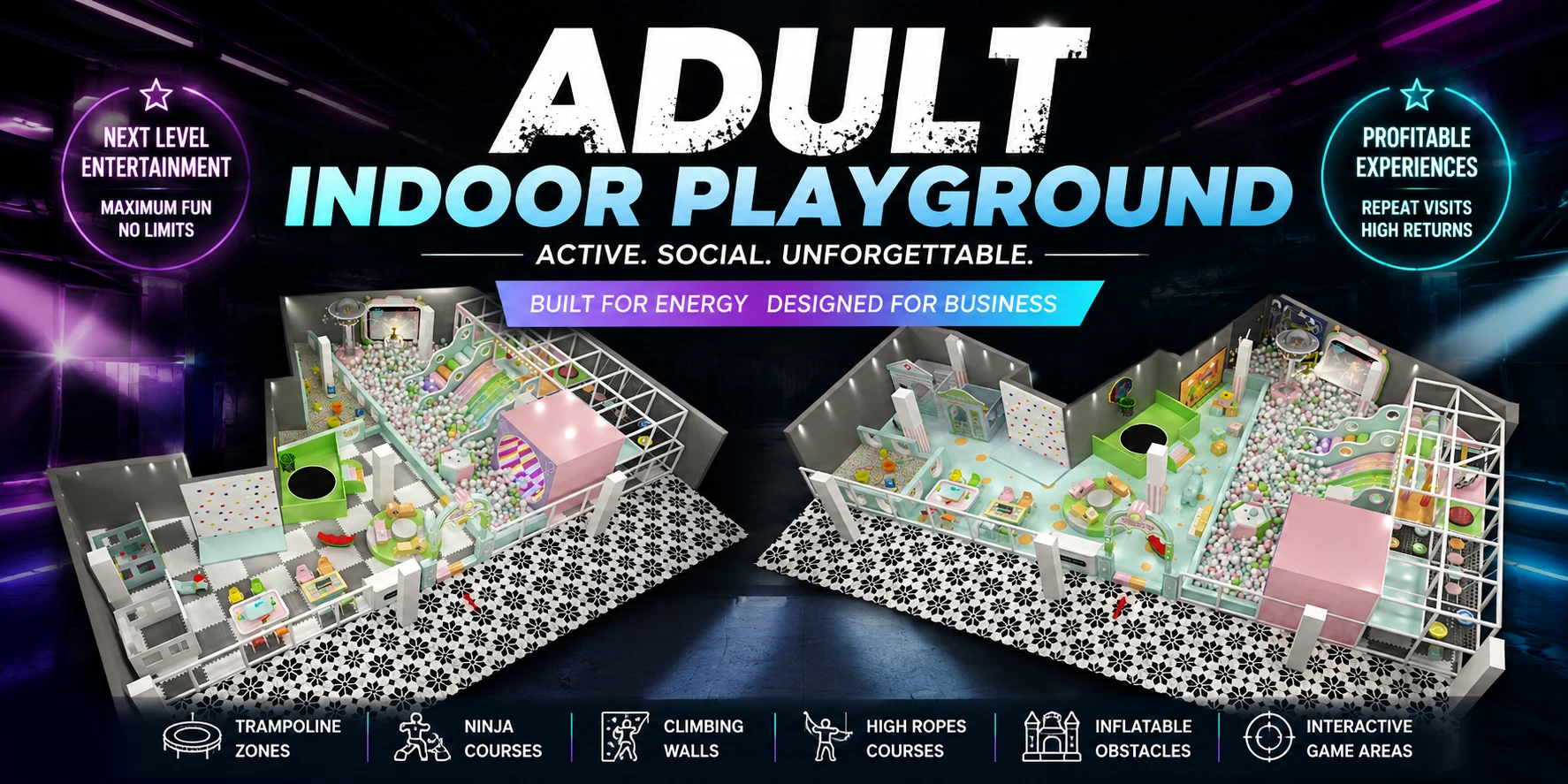
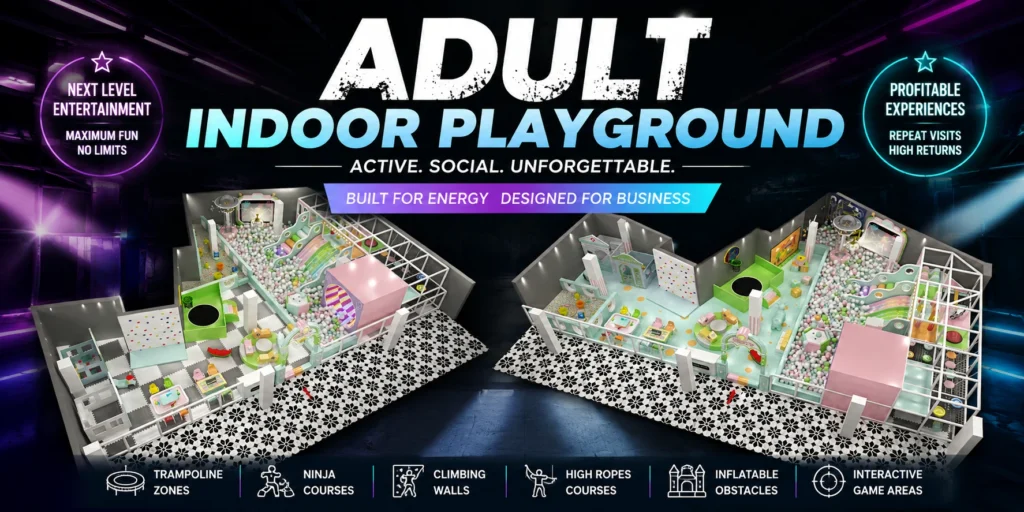
Adults now climb, jump, and race through indoor play spaces built for them. These venues blend fitness, social events, and entertainment, drawing groups who want active fun without a gym floor or a nightclub queue. An adult indoor playground is a large-format recreational facility with physical play attractions scaled and engineered for users over 16. This guide covers equipment categories, design differences, and business models to help you compare Wenzhou playground equipment suppliers with confidence.
Adult Indoor Playground Attraction Categories That Define Venue Design
Six attraction categories define adult indoor playground layouts, and each shifts your floor plan, budget, and audience mix.
- Trampoline zones: anchor attraction for fitness jumpers and dodgeball leagues; allow 200-400 m² of padded court.
- Ninja courses: competitive adults and party bookings need 4-5 m ceiling height and a 30-50 m timed obstacle run.
- Climbing walls: team-building clients want 6-9 m walls with bouldering bases; budget 100-200 m².
- High ropes courses: corporate groups expect 5-7 m clearance plus walkways engineered for adult loads.
- Inflatable obstacle courses: flexible hire venues value units that pack down overnight and need 300-500 m².
- Interactive game areas: social groups and soft openings suit 50-150 m² projection zones without heavy steelwork.
Dreamland’s top-10 list confirms trampolines and ninja lines drive repeat visits, while Ninescape’s design guidance pairs high-ropes and climbing for mixed-format venues.
Design and Layout Considerations for Adult Play Structures
Design for the heaviest adult load, not the average. Ninescape guidance specifies minimum 4.5 m ceiling heights, with 6 m or more reserved for high-ropes and aerial courses. Steel frames should carry 150 kg per user plus dynamic impact, so specify thicker-gauge box section and high-tensile fasteners — the bolt-and-soft-foam approach used in children’s play does not transfer.
Protect every fall: 3-4 cm impact-absorbing rubber or EVA tiles under climbing zones, certified safety nets around elevated routes, and clearance zones of at least 1.5 m around each platform’s edge. Plan traffic flow around mixed activities too. Separate bouncing, climbing and social zones with clear sightlines, one-way entry points and 2 m-wide walkways so groups move without colliding. That layout discipline keeps a 1,000 m² adult indoor playground floor plan working at peak hours.
Key Differences Between Adult and Children’s Indoor Playgrounds
Adult and children’s playgrounds share a playful look but little else on the specification sheet. Compare these five factors before you source equipment.
| Aspect | Children’s playground | Adult playground |
|---|---|---|
| Safety standards | EN 1176 soft play with low fall heights and enclosed netting | Higher fall-height certification and industrial anchor points rated for adult loads |
| Equipment scale | Compact platforms sized for users under 1.5 m | Oversized frames, extended ninja lines and 3 m+ climbing walls |
| Material durability | Foam, PVC and light plastic that wears quickly | Galvanised steel, impact-resistant PE board playground equipment and industrial fasteners |
| Supervision needs | Constant staff-to-child ratios and zone monitoring | Self-supervised with safety briefings and periodic floor checks |
| Activity types | Slides, ball pits, tunnels and soft blocks | Trampolines, ninja courses, high ropes and competitive game zones |
These differences drive procurement decisions. Adult-rated equipment typically costs more per square metre than children’s soft play, so request load-test documentation, anchor certification and spare-part lead times before quoting. Steel-framed structures also carry heavier freight and installation requirements, so confirm site access and crane or lift needs during planning. Ask suppliers whether their adult ranges are purpose-built or adapted children’s units, and check that replacement parts match the original load rating.
Business Models and Revenue Streams for Adult Indoor Playgrounds
Most adult indoor playgrounds run on four income streams: pay-per-session entry, monthly memberships, event rentals and food and beverage. Play Playground Las Vegas and Wonderfly Arena sell session passes with tiered pricing, while memberships cover quieter weekday hours. Corporate team-building, adult birthdays and bachelor parties are the highest-margin rentals because they book the whole venue.
Your attraction mix sets the price ceiling. Ninja courses and trampoline zones justify premium session rates — they consume more floor area and supervision than a climbing wall or café corner. Use Ninescape’s ‘how they make money’ section alongside local venue rates to price sessions, then position your bar and seating near the exit to capture post-session spend.
About JQ Playground – wenzhouplaygroundequipment.com
JQ Playground (Wenzhou Jiqi Amusement Equipment Co., Ltd.) is a children’s playground equipment manufacturer founded in 1993. The company provides design, customization, large-scale manufacturing, sales, installation guidance, and after-sales support for outdoor playgrounds, indoor playgrounds, soft play, water playgrounds, PE board playgrounds, kindergarten furniture, outdoor fitness equipment, pet playgrounds, and playground facilities. Approved company facts include 180+ employees, a large Wenzhou production base, 20+ production lines, 55 production machines, ISO/BSCI/EN1176/EN71/ASTM/CPC/CPSIC certification references, 100+ patents, free design support, OEM/ODM capability, trial installation before shipping, export experience, and one-year quality warranty.