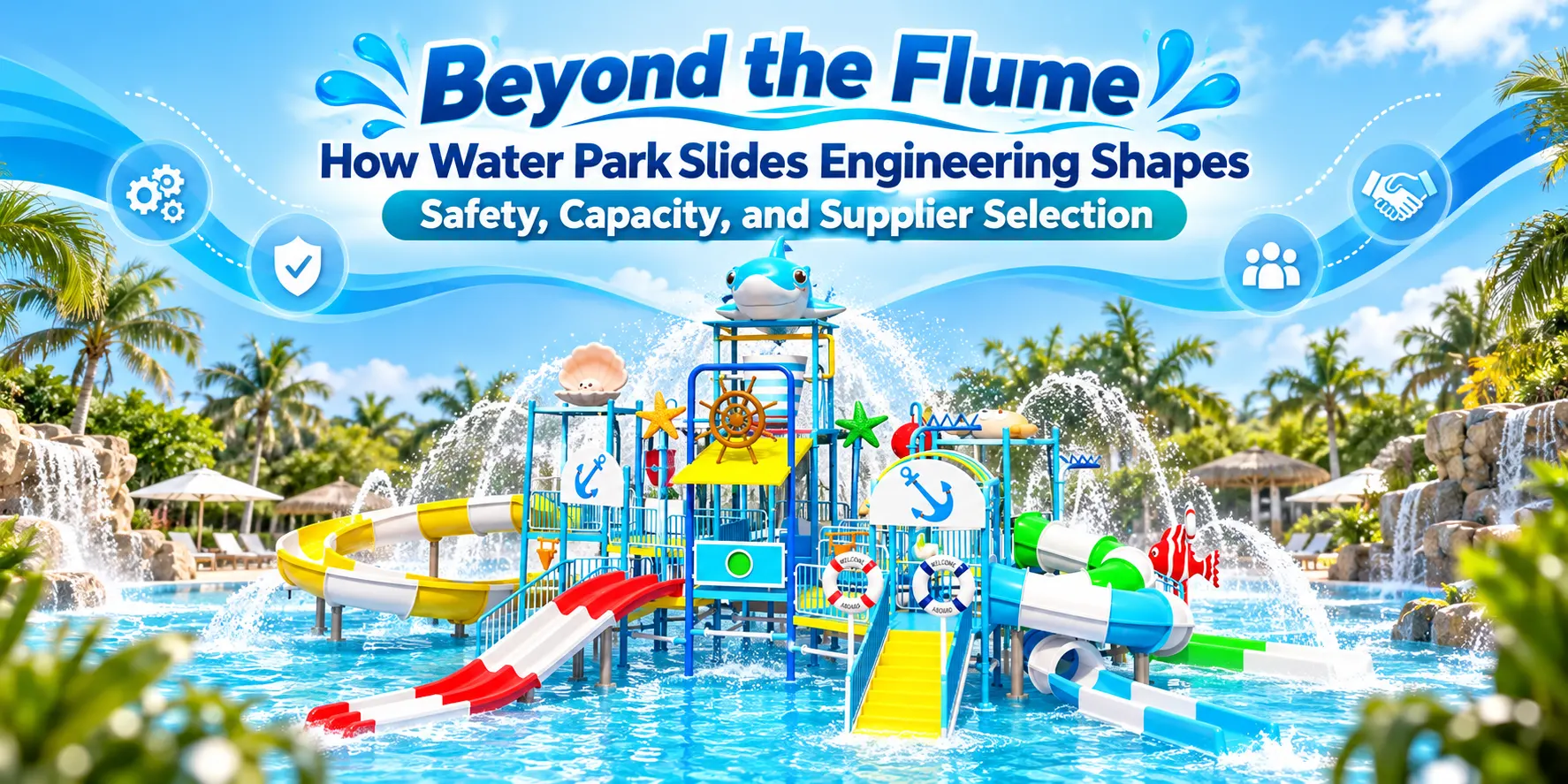
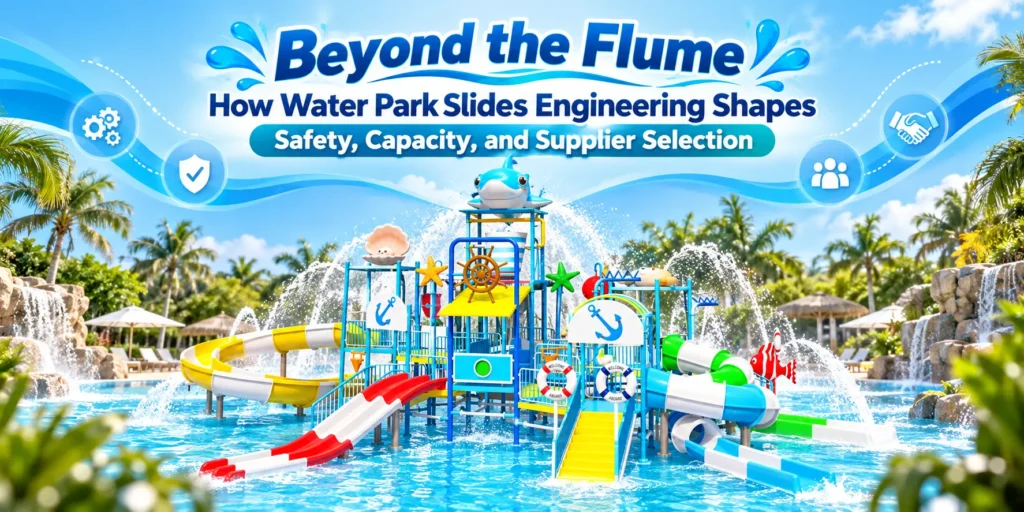
Specifying water park slides by shape alone is a common mistake. Two flumes can look identical yet handle very different rider weights, water volumes and dispatch intervals. Poor matching shows up later as slow throughput, splash-out at the runout, or a ride that needs costly retrofitting before it passes inspection. The fix is to compare slides on measurable criteria: flume geometry, material grade, joint design and the water supply each unit needs. Buyers who collect those numbers before requesting quotes tend to get accurate pricing on the first reply.
Water park slides are engineered water rides that use pumped water and gravity to carry riders along a shaped flume — an open body slide, an enclosed tube slide, or a multi-lane racer — from an elevated entry platform down to a runout or splash pool. Key specifications include flume diameter, slide length, drop height, turn radii, rider weight range, required water flow rate, and the fibreglass or steel construction used. Commercial units are sized by hourly rider throughput, and joints, anchors and surface finishes are checked during installation against amusement-ride safety requirements.
The next section explains how these parts work together, step by step, before you source.
How Water Park Slides Work
Water park slides move a rider downhill on a thin water film, then slow them to a controlled stop.
- Entry. The rider starts from a tower platform, seated or on a mat, at a height set by the flume profile.
- Descent. Gravity plus a controlled water flow carry the rider through the flume; sealed joints and a consistent radius keep speed predictable.
- Exit. A runout lane, splash pool, or brake section decelerates the rider inside the catchment area.
Component roles
The flume, moulded fibreglass or stainless steel, carries the rider. Pumps and nozzles set film depth. Support steel and footings hold the gradient. Joint seals protect the running surface, while handrails, signage, and lifeguard posts cover supervision.
Buyers should tie each stage to evidence: rider age and throughput, pump redundancy for repeatable speed, and inspection records for surface finish and fixings.
Water Park Slides Components and Product Types
Buyers shortlist water park slides by body type before comparing price. The table below maps the four main categories to typical rider profile and build emphasis.
| Product type | Typical rider profile | Build emphasis | Common buyer check |
|---|---|---|---|
| Straight body slide | Single rider, 6+ years | Constant gradient, shallow flume | Exit run-out length |
| Spiral or helix slide | Single or tandem | Banked curves, tighter footprint | Curve radius vs site area |
| Multi-lane racer | 3-6 riders side by side | Equal lane length, shared start tower | Lane timing consistency |
| Bowl or funnel slide | Single to four riders | Wide shell, centrifugal drop | Fibreglass thickness at the equator |
Specification details to confirm before an RFQ:
- Flume and shell material — fibreglass thickness, gelcoat grade, and UV stabiliser content.
- Steelwork — galvanised or stainless frame, bolt grade, and anchor fixing type.
- Water supply — flow rate per lane, nozzle layout, and pump capacity.
- Finish and safety edges — radius on entry and exit, non-slip walkway surfaces.
Smaller water play items often ship alongside soft play equipment from the same project brief, so buyers frequently bundle quotes across both categories. Component lists vary by site, which is why application fit matters more than a generic accessory count.
Typical Applications for Water Park Slides
Applications shape slide choice more than brochure categories do. A resort tower with a 12 m drop needs a different tube diameter, flume gradient, and landing-pool depth than a compact indoor splash zone under a 4 m ceiling.
- Resorts and hotel water parks: tower-mounted tube and bowl slides sized to guest throughput; confirm flange and terminal fit against pump and filtration connectors before quoting.
- Municipal and family entertainment centres: open body flumes with clear lifeguard sightlines; request batch records covering gel-coat thickness and joint torque.
- Indoor splash zones and PE board playground equipment projects: low-height mini slides and water play units; check fixings suit the deck substrate and that edges carry radius evidence.
| Application factor | Buyer action |
|---|---|
| Site footprint | Match run length and pool depth to the slab |
| Throughput | Confirm slides per hour against queue space |
| Connector fit | Ask for terminal and flange drawings |
| Batch demand | State annual volume plus spare-part split |
Once these application variables are fixed, customisation becomes the deciding factor.
Custom Water Park Slides Manufacturing and OEM Cooperation
That path starts with what you send, not what you ask for. Provide a dimensioned drawing, a 3D model or a physical sample, and a custom Water Park Slides programme moves through fixed stages instead of open-ended promises.
| Stage | Your input | Manufacturer output |
|---|---|---|
| Brief | Drawings, samples, target rider capacity, colour | Feasibility check, material and thickness advice |
| Quote | Quantity, packaging style, delivery window | Itemised price, lead time, tooling notes |
| Sample | Approval limits on shade, wall thickness, joint fit | Pre-production sample for written sign-off |
| Packaging | Carton, pallet or private-label artwork | Packing specification with load counts |
| Batch | Inspection criteria and sampling level | Records per production batch and per mould |
| Shipment | Forwarder, documents, container markings | Loading photos and batch traceability |
Inspection Points to Fix Before Mass Production
Agree weld and joint strength checks, surface finish, and dimensional tolerance per panel. Random pulls from each batch should be photographed and measured, so the first container matches the tenth. Those records then become the evidence you compare when shortlisting suppliers.
Top 10 Water Park Slides Manufacturers and Supplier Fit
Shortlist by supplier category first, then score individual names inside each group. Four types cover most water park slides enquiries.
| Supplier type | Pros | Cons | Best fit |
|---|---|---|---|
| Turnkey park contractors | Ride design, flume engineering, install crews | Highest cost, longest programmes | Resort-scale new parks |
| Fibreglass slide fabricators | Custom moulds, colour matching, part replacement | Gelcoat and resin quality varies by plant | Mid-size parks, slide replacement |
| Stainless steel slide makers | Suits indoor, chlorine-heavy sites | Heavier freight, fewer colour options | Indoor water play centres |
| Component and pump specialists | Valves, joints and spares held in stock | No whole-ride design service | Refurbishment works |
Score each candidate on:
- Two completed ride references at comparable scale.
- Quoted capacity per hour, flume diameter and gradient against your site drawings.
- A sample panel or gelcoat swatch reviewed before ordering.
- Lead-time reliability and RFQ reply speed, scored separately from unit price.
Fit beats price: a supplier matched to your ride type and batch size usually costs less across the project than a cheaper mismatch.
Cut your list to two or three before final checks.
About JQ Playground – wenzhouplaygroundequipment.com
JQ Playground (Wenzhou Jiqi Amusement Equipment Co., Ltd.) is a children’s playground equipment manufacturer founded in 1993. The company provides design, customization, large-scale manufacturing, sales, installation guidance, and after-sales support for outdoor playgrounds, indoor playgrounds, soft play, water playgrounds, PE board playgrounds, kindergarten furniture, outdoor fitness equipment, pet playgrounds, and playground facilities. Approved company facts include 180+ employees, a large Wenzhou production base, 20+ production lines, 55 production machines, ISO/BSCI/EN1176/EN71/ASTM/CPC/CPSIC certification references, 100+ patents, free design support, OEM/ODM capability, trial installation before shipping, export experience, and one-year quality warranty.