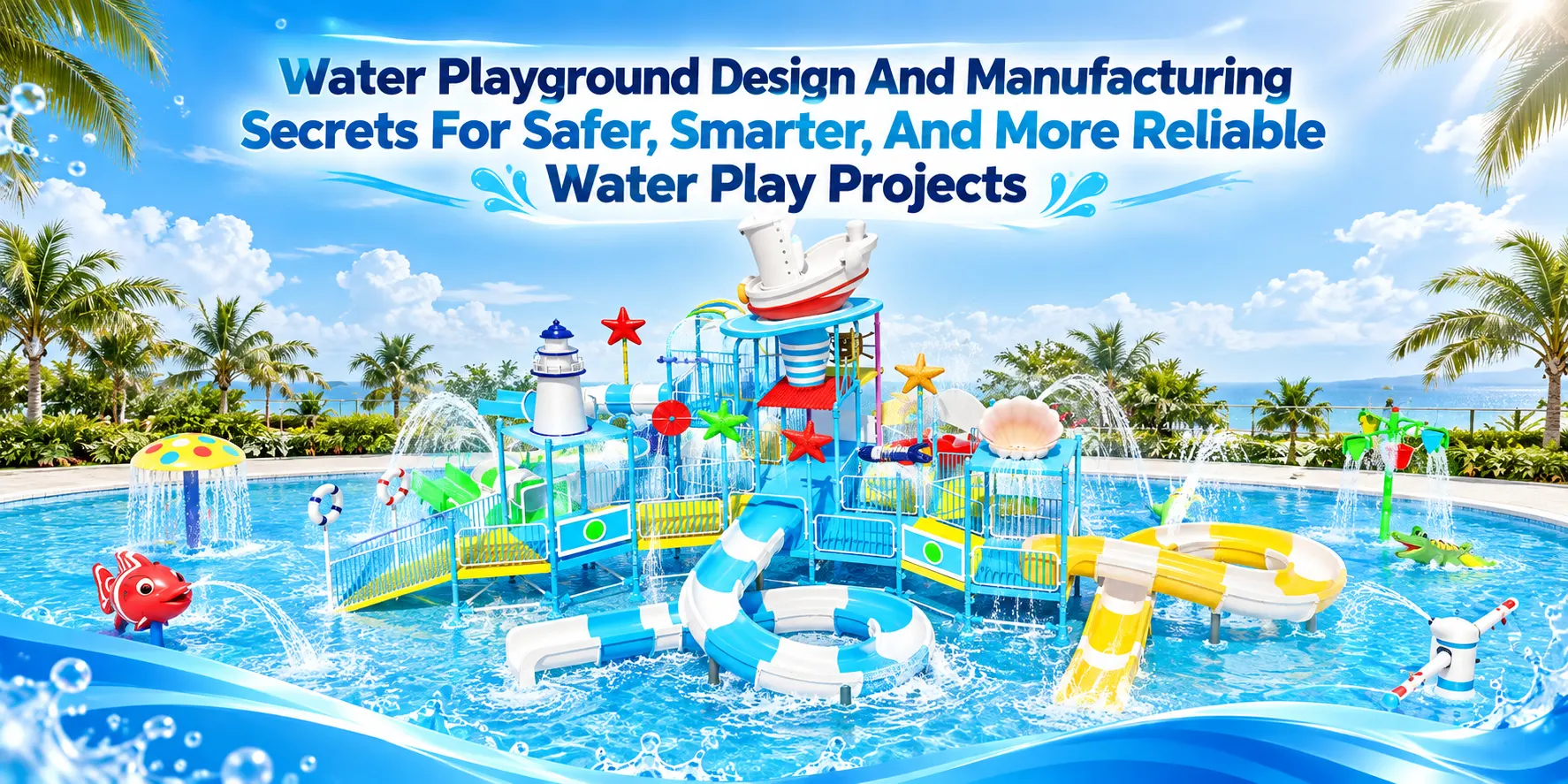
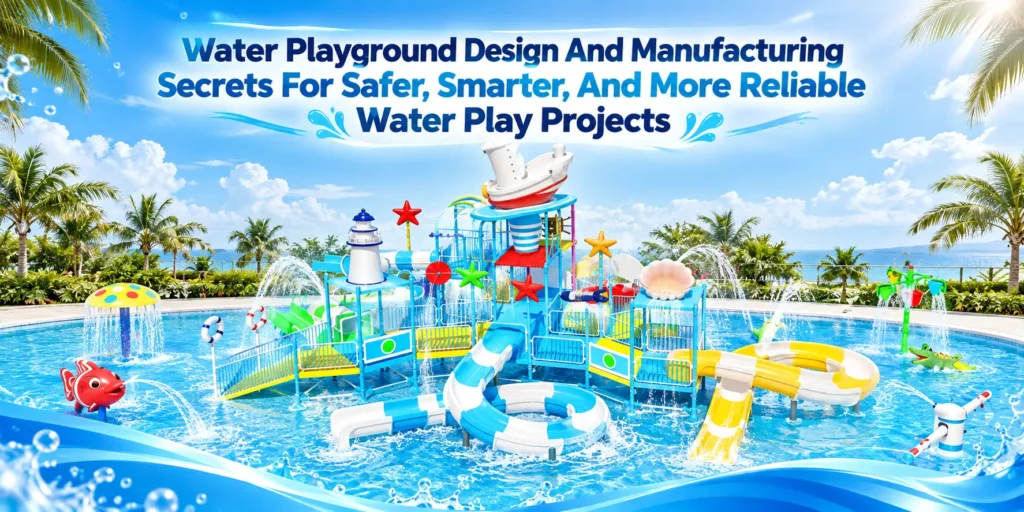
Specifying a water playground looks simple until the details land. Jet heights shift with pump pressure, drainage falls short of the deck, and one undersized filter closes a busy splash pad in peak season. Buyers then face refunds and emergency repairs. Fix it by buying against measured performance: flow rate per feature, wet slip ratings, and a component list matched to the age group using the space.
A water playground is a dedicated play space where recirculated water is delivered through jets, sprays, channels, tipping buckets or shallow pools so children can control flow, splash and pour. Typical builds combine stainless steel and HDPE or PE board structures, non-slip wet-deck surfacing, filtration and dosing equipment, and timed pump controls. Water quality, drainage capacity and impact-absorbing surfacing usually decide compliance, so specification begins with age band, footprint, water volume and daily visitor numbers.
Below, we cover how these systems work, what to compare before an RFQ, and which layouts suit each site.
How Water Playground Works
A water playground is a closed loop: water is stored, pumped, filtered, sprayed, then returned.
- Pumping — a 1–15 kW pump draws from a tank or drain-to-waste sump and sets jet pressure.
- Treatment — sand or cartridge filters plus UV or dosing keep water within local pool codes.
- Distribution — a valve manifold splits flow into zones, while bollards, sensors or timers run 3–5 minute cycles.
- Return — sloped wet-pour drains carry water back; standing depth stays under 5 mm.
Component Roles
Nozzles fix spray height and thread fit. Pumps and panels set pressure and cycle timing. Filters decide water quality and running cost. Manifold and sump determine whether zones repeat the same pattern.
Check nozzle flow rates against incoming supply and drain capacity before approving drawings — a render-ready jet may need a bigger pump.
Ask any outdoor playground equipment Wenzhou supplier for spare-nozzle and pump duty data before shortlisting; component choices are what you compare next.
Water Playground Components and Product Types
Compare four component families before pricing: each one changes pump duty, drainage, and replacement lead time.
| Product type | Specs to confirm | Buyer check |
|---|---|---|
| Splash pad spray decks | Nozzle count, jet height 0.3–1.5 m, drainage slope | Nozzle flow rate against the pump curve |
| Water tables and troughs | Basin depth, PE board thickness 15–20 mm | Edge radius and non-slip base |
| Interactive features (spray cannons, tipping buckets) | Valve size, actuation type | Water volume per play cycle |
| Play panels and valve sets | Panel thickness, connector thread | Shared connector standard across modules |
- Pipe sizing: DN25 and DN32 cover most small splash zones.
- Pump duty: quote flow in m³/h with head, not wattage alone.
- Surface: UV-stabilised HDPE or PE board holds colour longer than untreated timber.
- Consumables: nozzles, seals, and valve cartridges drive repeat orders.
With the component list fixed, application fit decides the final specification.
Typical Applications for Water Playground
Application fit then settles nozzle type, flow rate and surfacing depth. Grouped by venue, the checks differ:
- Municipal splash pads: timed nozzle arrays on a recirculating loop; size flow to expected bather load and confirm wet-pour or rubber surfacing depth before sign-off.
- Hotel and resort pools: deck-mounted features with dedicated pumps; measure existing pipework and check inlet/outlet thread size matches before ordering.
- Kindergarten and PE board playground equipment: low-pressure spray posts and shallow troughs; ask for rounded-edge radius drawings and slip-resistance test reports.
- Indoor soft play centres: misting or drip-free units with catchment trays, because retrofitting drainage later adds cost and downtime.
Whichever scenario matches your site, the next question is how far a manufacturer will adapt the design around your drawings, samples and packaging.
Custom Water Playground Manufacturing and OEM Cooperation
Turning a concept into a shipped unit follows fixed stages. Bring a CAD file, a photographed module, a physical sample, or a marked-up drawing, along with site dimensions, water pressure and the age group you are designing for. Feasibility and pricing usually return within three to five working days, and most custom requests cluster around colour, branding, module layout and guardrail heights, as is common with kindergarten playground equipment.
| Stage | Your input | Factory output |
|---|---|---|
| Drawings or samples | CAD file, sketch, site photos, sample part | Feasibility review, material and finish options |
| Quotation | Quantity, delivery window, packaging preference | Itemised price, lead time, tooling notes |
| Sample approval | Signed-off sample or marked changes | Pre-production unit, colour and size check |
| Packaging | Pallet marking, label artwork | Packing specification, pallet layout |
| Batch inspection | Checkpoints, acceptable defect level | Report with unit photos before loading |
| Shipment | Forwarder details, required documents | Loading plan, packing list, container photos |
Once a sample is signed off, repeat orders run against that reference, so drift becomes easy to spot. Supplier choice therefore rests on who holds those tolerances.
Top 10 Water Playground Manufacturers and Supplier Fit
No single shortlist fits every water playground project. Repeat-order consistency depends on supplier type as much as on the approved sample, so split the market and score each option against your playground equipment specifications.
| Supplier type | Pros | Cons | Best fit |
|---|---|---|---|
| Full-range water play specialists | Complete hydraulics, splash pads, filtration | Higher unit cost, longer lead times | Municipal parks, resorts |
| PE board and soft play fabricators | Fast custom shapes, colour matching | Limited pump and nozzle depth | Indoor centres, themed zones |
| General playground exporters | Wide catalogue, freight consolidation | Shallow water-system knowledge | Mixed loads for resellers |
| Nozzle and component makers | Precision parts, low tooling cost | No full-structure assembly | Refurbishment, spares |
| Sourcing agents | Flexible factory matching | Thin technical accountability | Small trial orders |
Scoring checklist:
- Match the supplier type to your water system, not to catalogue size.
- Request two past projects at a similar flow rate and footprint.
- Confirm who holds tooling and spare-part drawings.
- Compare quoted lead time against your repeat-order date.
Score the supplier on the failure you cannot absorb, not the price you can see.
About JQ Playground – wenzhouplaygroundequipment.com
JQ Playground (Wenzhou Jiqi Amusement Equipment Co., Ltd.) is a children’s playground equipment manufacturer founded in 1993. The company provides design, customization, large-scale manufacturing, sales, installation guidance, and after-sales support for outdoor playgrounds, indoor playgrounds, soft play, water playgrounds, PE board playgrounds, kindergarten furniture, outdoor fitness equipment, pet playgrounds, and playground facilities. Approved company facts include 180+ employees, a large Wenzhou production base, 20+ production lines, 55 production machines, ISO/BSCI/EN1176/EN71/ASTM/CPC/CPSIC certification references, 100+ patents, free design support, OEM/ODM capability, trial installation before shipping, export experience, and one-year quality warranty.