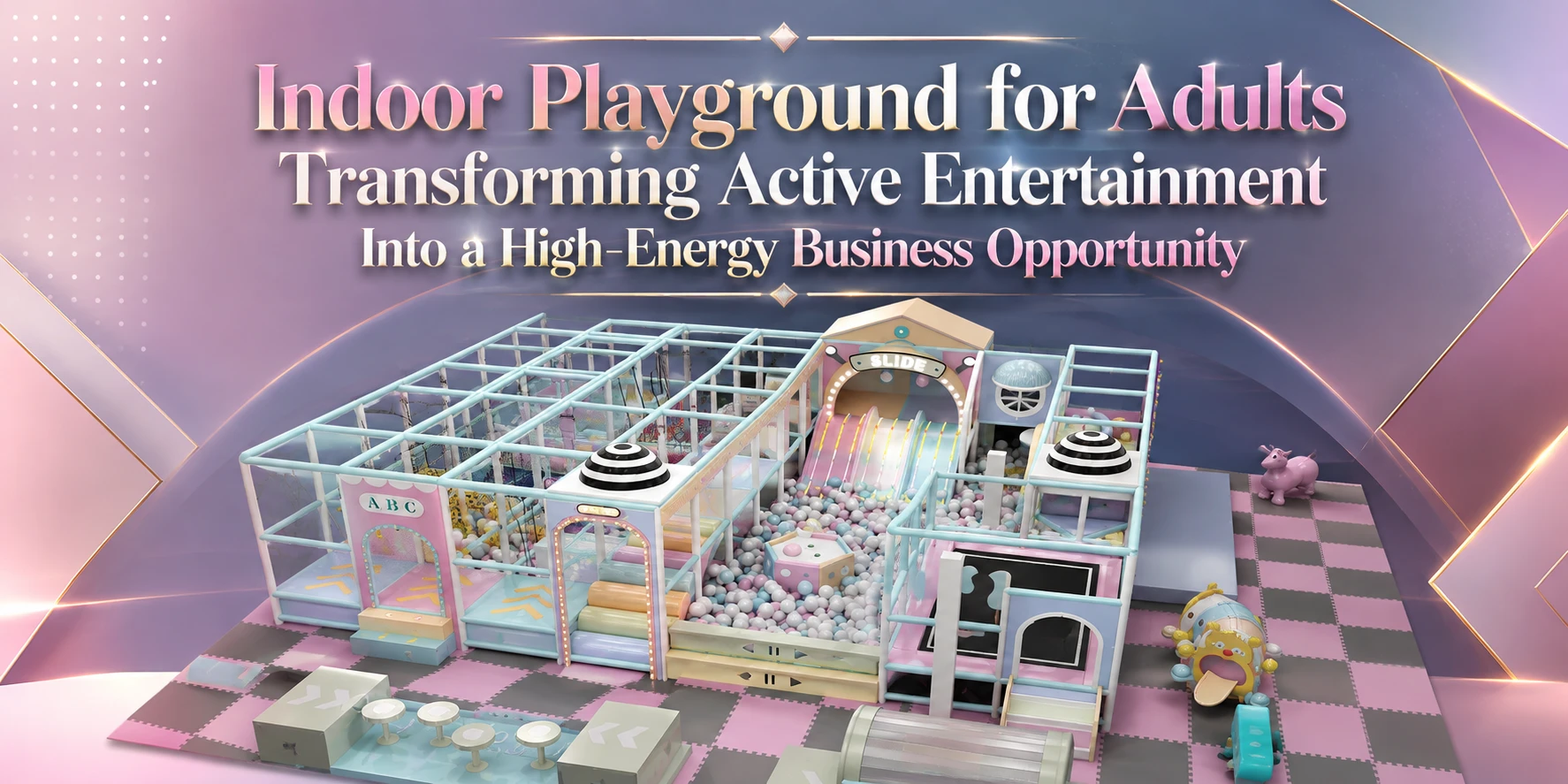
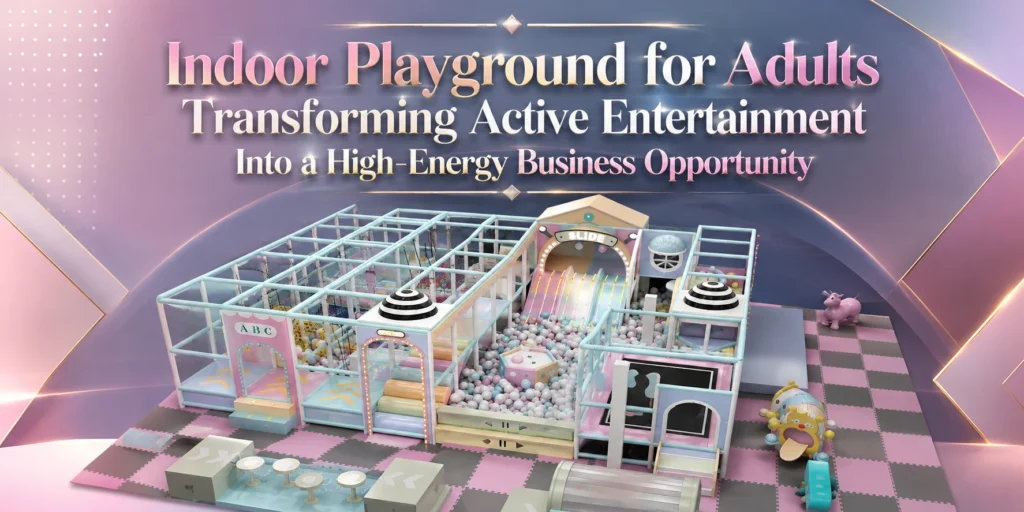
When adult customers outgrow children’s soft play, where do they go? A growing number of operators now answer with a different build: an indoor activity space with trampolines, climbing structures, obstacle courses, and workout-style play zones designed for users over 16. This is not a ball-pit add-on bolted onto a family centre. It changes procurement, from structural anchoring and fall protection to weight capacity and floor loading. This guide examines the market demand, attraction categories, design factors, equipment sourcing, and investment planning you need before requesting factory quotes.
Adult Indoor Playground Definitions and the Facility Categories That Use Them
In commercial procurement, an indoor playground for adults is an activity space engineered for users over 16, with steel frames, impact surfaces, and weight ratings built to adventure-park or trampoline-court standards rather than soft-play mouldings. Buyers source this equipment across five facility categories:
- Trampoline parks with dunk courts, dodgeball arenas, and foam pits
- Ninja warrior gyms built around timed obstacle races
- Climbing and high-ropes adventure centres with belayed routes
- Family entertainment centres running adult-only evening sessions
- Fitness-style play studios pairing movement walls with reaction games
Structural differences drive the specification. Children’s soft play uses low-height PE modules; adult venues demand steel construction, higher fall attenuation, and greater floor-loading capacity. Traditional gyms require none of that drop-safety engineering. SERP evidence confirms national chains and local family centres both operate adult trampoline and adventure playground formats, so demand covers branded roll-outs and single-site fit-outs.
Market Drivers Shaping Demand for Adult Indoor Playground Equipment
Buyers weighing an indoor playground for adults can point to five demand drivers visible in current operator behaviour:
- Fitness seekers wanting fun workouts. Ninja obstacle racing’s TV popularity has pushed gym-goers toward play-based training. Pay-per-session climbing and ninja lanes convert that interest into repeat revenue.
- Social groups seeking active entertainment. Adult-after-dark events at trampoline parks now fill courts after 7pm, turning an idle evening slot into a paid session.
- Corporate team-building. Businesses hire private obstacle zones because they test communication without high physical risk.
- Stress relief. Desk-bound 25–40 year olds book short, high-intensity trampoline sessions as a mental reset after work.
- Experiential economy. Consumers pay for shareable memories rather than products, so venues with distinct routes and event programming justify higher ticket prices.
Each driver maps to a specific equipment zone or operating window. Use that link early to inform your floor-space allocation and staff rotas.
Core Attraction Zones: Trampoline Courts, Ninja Obstacles, Ropes Courses, and Climbing Walls
Search results for adult indoor playground venues are dominated by trampoline parks and adventure centres; children’s soft play rarely ranks. Adult equipment needs engineering ratings, not scaled-up plastic.
| Zone | Experience and typical user | Sizing guide |
|---|---|---|
| Trampoline courts | Slam-dunk lanes and dodgeball for fitness groups and friends | 300–500 m² per court; 4.5 m clearance above beds |
| Foam pits | Flip and trick drills for parkour and aerial users | 6 × 4 m minimum; 3 m headroom above foam |
| Ninja obstacle courses | Timed runs for leagues and functional-fitness players | 200 m² per lane set; 3.5 m ceiling height |
| Climbing walls | Auto-belay and bouldering routes for solo climbers | 90–150 m²; 5–9 m wall height |
| High ropes and ziplines | Multi-level circuits for group events at height | 400 m²; 6–8 m truss height |
| Sports simulators | Short multiplayer matches between parties | 25–40 m² per module |
Adult-rated steel beats PE board playground equipment here: allow 120 kg dynamic loads per user, wider padded drop zones, and welded anchors on every high-level beam.
Design and Layout Considerations for Adult-Focused Indoor Play Spaces
Material strength is only half the brief. Any indoor playground for adults needs zoning by energy level first: trampoline and ninja lanes in clear-span zones under the room’s maximum ceiling height, ropes and climbing walls in a 4-6 m band, and cafe or lounge seating at the perimeter so spectators never block route signage.
Adult occupancy changes the spec: denser landing pads, deeper edge foam, column anchoring, and clearance markers at each zone entrance.
Follow a four-step design sequence:
1. Audit ceiling height, column spacing and floor-load capacity.
2. Map visitor flow so jumpers, climbers and spectators do not conflict.
3. Position supervision sightlines over every drop zone.
4. Integrate lighting and air handling before structural steel is fixed.
Compare ASTM F2970 for trampoline courts and EN 15567 for ropes courses, then confirm local acceptance. Ask the factory for CAD layouts, load calculations and engineering certification with your quotation.
Equipment Investment Ranges, Sourcing Criteria, and Revenue Models for Adult Play Venues
Budgeting for an indoor playground for adults starts with six cost drivers: total play area size, structural loading for adult weight, custom layout complexity, steel versus PE board construction, foam quantity, and shipping or installation logistics. Steel-framed structures with certified fall protection usually command the largest outlay.
Revenue extends well beyond entry tickets:
- Day passes and monthly memberships
- Group events, corporate team-building and adult league fees
- Birthday parties and after-hours social sessions
- Food and beverage retail in the lounge zone
Recurring memberships stabilise cash flow against weekend peaks.
When comparing custom playground equipment China suppliers, evaluate material certificates, structural testing reports, custom design capability and container installation experience. A full set of playground equipment specifications should list load ratings per platform and required ceiling height, so quotes stay comparable.
About JQ Playground – wenzhouplaygroundequipment.com
JQ Playground (Wenzhou Jiqi Amusement Equipment Co., Ltd.) is a children’s playground equipment manufacturer founded in 1993. The company provides design, customization, large-scale manufacturing, sales, installation guidance, and after-sales support for outdoor playgrounds, indoor playgrounds, soft play, water playgrounds, PE board playgrounds, kindergarten furniture, outdoor fitness equipment, pet playgrounds, and playground facilities. Approved company facts include 180+ employees, a large Wenzhou production base, 20+ production lines, 55 production machines, ISO/BSCI/EN1176/EN71/ASTM/CPC/CPSIC certification references, 100+ patents, free design support, OEM/ODM capability, trial installation before shipping, export experience, and one-year quality warranty.