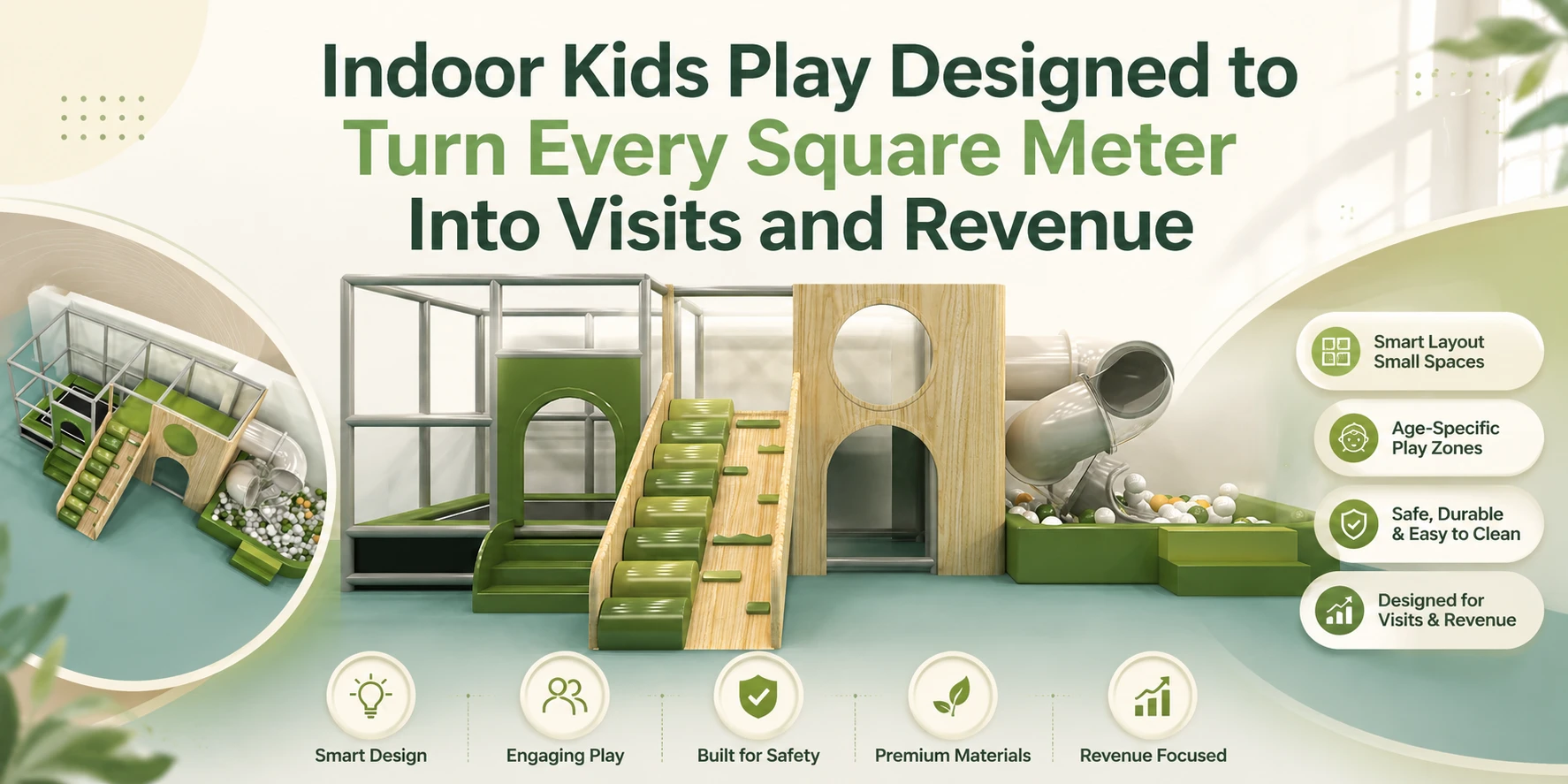
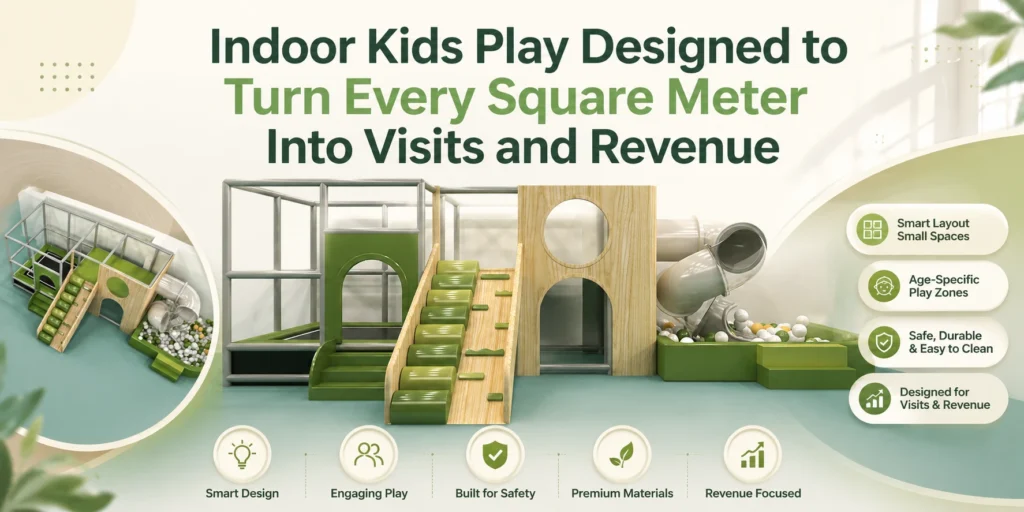
When you search indoor kids play, you see a crowded market of local centres that look interchangeable from the outside. The real uncertainty is which equipment actually drives visits and which layouts earn their floor space. Indoor kids play refers to climate-controlled playgrounds with age-specific attractions such as slides, ball pits, trampolines, and climbing structures, often packaged with party services and open-play sessions. For facility owners and equipment buyers, the operational priorities of these venues determine which equipment and layouts will succeed.
Common Attractions in Indoor Kids Play Facilities
The features that draw repeat visits also define your procurement list. Across SERP sources — Fit Kid Play, Ocean’s Playhouse, KidsZone — six attractions recur:
- Slides: best for ages 2–8; source moulded plastic or roller slides from commercial playground equipment Wenzhou factories.
- Ball pits: ages 1–6; source foam-edged pits with hygienic, wipeable ball supplies.
- Trampolines: ages 4–12; source recessed units with perimeter padding and safety enclosures.
- Arcade games: ages 5–12; source redemption or ticket-based amusement machines.
- Ninja courses: ages 6–12; source obstacle elements with continuous foam fall coverage.
- Soft play structures: ages 6 months–5 years; source modular foam or PE board builds.
Local directories such as Yelp and Hudson Valley guides market “variety” above any single ride, so suppliers must offer modular or multi-activity designs that let you reconfigure zones without re-buying frames.
Age-Specific Play Zones: Design and Safety Considerations
Zone design determines both safety compliance and repeat visits. ASTM F2376 and EN1176 govern material choice, edge rounding, and fall height, so confirm compliance before ordering.
Toddler (0–18 Months)
Low crawl cubes, sensory panels, and shallow foam pits with soft balls. Continuous foam matting must cover the entire fall zone. Keep barriers under 800 mm so carers can spot children from seating areas.
Preschool (18 Months–4 Years)
Mini slides, wave slides, and low climbing frames with wide platforms. Rubber tiles or 40 mm interlocking foam absorb impacts from standard 1 m fall heights. Rounded edges and finger-gap checks matter most here.
School-Age (5–12 Years)
Multi-level structures, tube slides, and trampolines. Higher fall heights demand thicker impact surfacing and net barriers. Staff sightlines can narrow, but keep critical junctions open for supervision.
Factory Evaluation Checklist
- Request ASTM F2376 and EN1176 test reports.
- Verify edge radius and fall-height ratings per zone.
- Check CAD drawings for clear sightlines.
- Confirm foam density and fire-retardant ratings.
Party and Event Packages That Influence Facility Layout
Once your age-zone layout clears the safety checks above, party packages dictate how that floor space earns revenue. Plan your space around the four features parents and schools actually book:
- Reserved party rooms — a lockable room with mobile partition walls converts open-play floor space into private hire areas fast.
- Themed decorations — ask suppliers for themed panel options, such as printed PE board playground equipment panels, or add-on decor packages that suit popular party themes without major renovation.
- Food service areas — a dedicated serving counter with wipe-clean surfaces plus foldable tables that store flat when the space returns to open play.
- Flexible seating — multi-use soft seating serves party guests, waiting parents, and everyday open-play rest zones alike.
Suppliers who bundle these panels and furniture options let you launch birthday parties, school trips, and private rentals without separate fit-out contractors — a genuine advantage in the party economy.
Playground Rules and How Equipment Supports Compliance
Once your layout handles parties, the posted rules take over daily operations. Most venues display the same five: socks required, adult supervision, age limits, no outside food, and no climbing on netting. Equipment design can enforce each one before staff intervene.
- Socks required — anti-slip flooring and smooth seam joints reduce barefoot injuries and speed up cleaning between sessions.
- Adult supervision — sightline mirrors and low-profile partitions let one attendant watch multiple zones from a fixed position.
- Age restrictions — colour-coded entry gates and zone-specific fall heights make limits obvious to parents.
- No outside food — lockable doors and dedicated party-room access keep food and drink away from ball pits and foam pits.
Ball pit hygiene also depends on removable, washable balls, drainage-friendly flooring, and fire-retardant foam. Choose playground facility equipment with EN1176 and ASTM F1918 certificates, plus sealed wood cores and lead-free paint, and you can defend every rule in writing during inspections.
About JQ Playground – wenzhouplaygroundequipment.com
JQ Playground (Wenzhou Jiqi Amusement Equipment Co., Ltd.) is a children’s playground equipment manufacturer founded in 1993. The company provides design, customization, large-scale manufacturing, sales, installation guidance, and after-sales support for outdoor playgrounds, indoor playgrounds, soft play, water playgrounds, PE board playgrounds, kindergarten furniture, outdoor fitness equipment, pet playgrounds, and playground facilities. Approved company facts include 180+ employees, a large Wenzhou production base, 20+ production lines, 55 production machines, ISO/BSCI/EN1176/EN71/ASTM/CPC/CPSIC certification references, 100+ patents, free design support, OEM/ODM capability, trial installation before shipping, export experience, and one-year quality warranty.