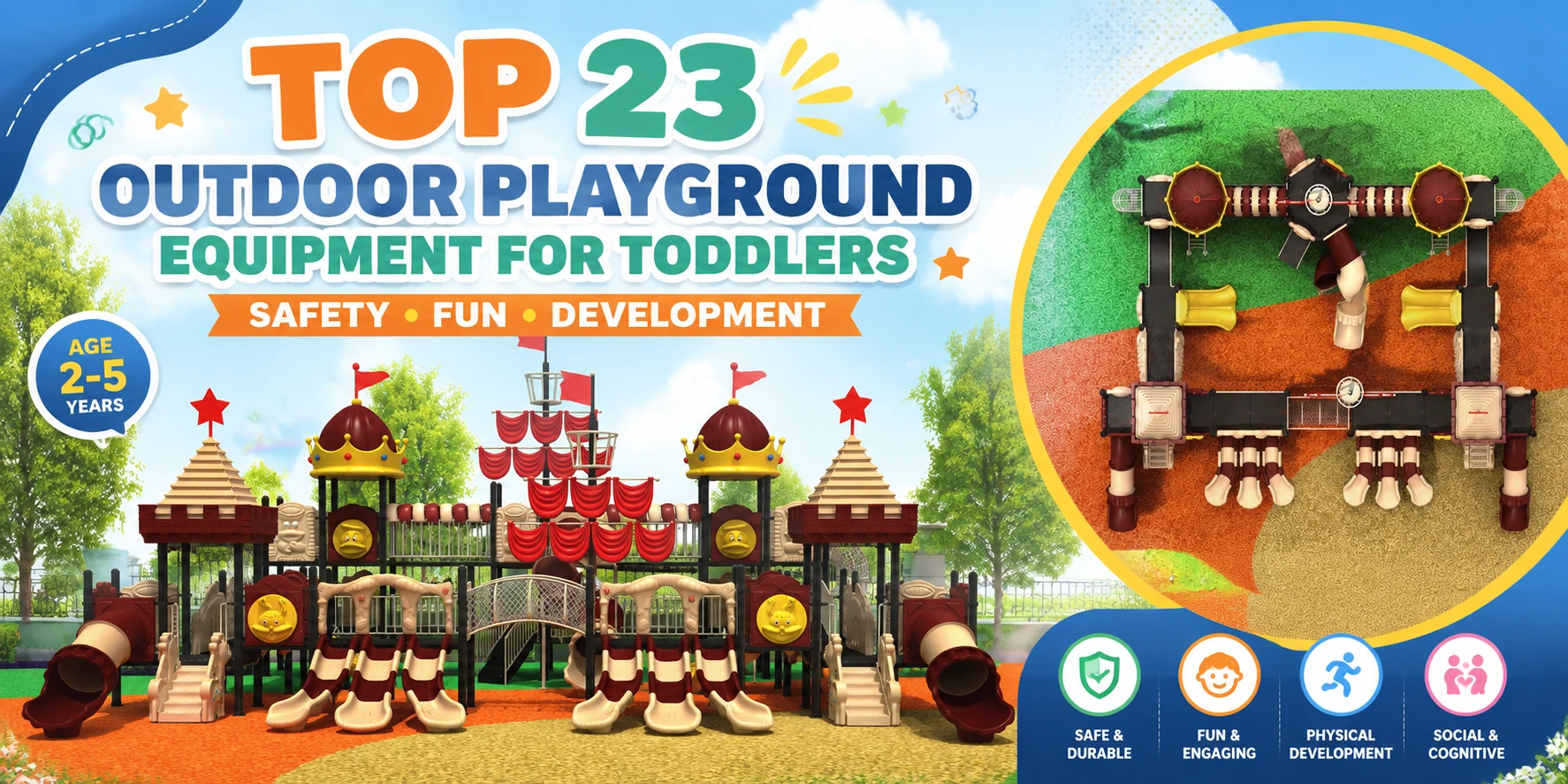
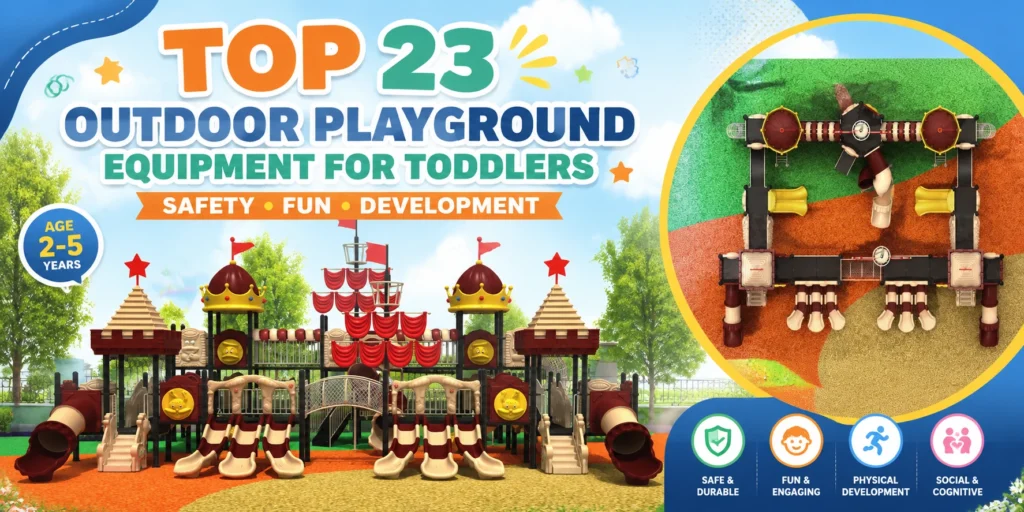
Choosing the right playground manufacturer for toddlers requires more than comparing colors, slides, and quoted prices. Buyers must consider age appropriateness, platform height, accessibility, material durability, safety surfacing, supervision visibility, customization, installation support, and long-term maintenance.
The term “toddler playground” can also cover two very different developmental groups: children aged 6–23 months and children aged 2–5 years. In the United States, ASTM F2373-24 addresses public-use play equipment for children aged 6–23 months, while ASTM F1487-25 covers public playground equipment beginning at age two. Buyers should therefore request clear, model-specific age ranges rather than purchasing equipment simply labeled “for young children.” (ASTM Store)
This editorial ranking evaluates manufacturers according to their toddler-specific product ranges, customization capabilities, material options, design services, international project support, and suitability for daycares, preschools, parks, residential communities, resorts, and commercial developments.
What Makes Toddler Playground Equipment Different?
Age-Appropriate Challenges
Toddlers need achievable physical challenges. Suitable equipment normally includes short slides, low climbing steps, crawl tunnels, small bridges, activity panels, playhouses, beginner balance elements, spring riders, musical components, and ground-level sensory activities.
Equipment designed for older children should not simply be reduced in size. Toddler structures require different access points, handhold dimensions, movement patterns, platform heights, barriers, and supervision conditions.
Clear Age Zoning
A playground serving children aged 6–23 months, 2–5 years, and 5–12 years should use clearly separated activity zones. This helps reduce traffic conflicts between crawlers, early walkers, preschool children, and more active school-age users.
The latest CPSC Public Playground Safety Handbook emphasizes age-appropriate design, maintained protective surfacing, equipment inspection, heat checks, and attentive supervision for toddlers and preschool-age children. (U.S. Consumer Product Safety Commission)
Developmental Play Value
Good toddler equipment should support several types of play within a compact area:
- Crawling, stepping, climbing, balancing, and sliding
- Tactile, visual, musical, and manipulative activities
- Pretend shops, vehicles, kitchens, houses, and themed panels
- Side-by-side and cooperative play
- Quiet spaces for children who need a break from active movement
The following manufacturers offer notable options for buyers sourcing commercial outdoor playground equipment for toddlers.
1. JQPlayground
Best for Custom International Projects and Factory-Direct Purchasing
JQPlayground is a Wenzhou-based commercial playground manufacturer supplying outdoor playgrounds, wooden playgrounds, PE board structures, customized playgrounds, accessible equipment, outdoor fitness products, water-play products, and kindergarten furniture. Its company information states that the business has operated since 1993 and serves customers in international markets. (JQ Playground)
For project buyers searching for outdoor playground equipment for toddlers, JQPlayground provides a particularly broad range of configuration possibilities. A toddler project can incorporate short slides, low-access stairs, crawl tunnels, compact bridges, steering panels, beginner balance beams, spring riders, playhouses, and musical panels. These elements can be combined into a complete play system or distributed throughout a smaller daycare or preschool play area. (JQ Playground)
One of the company’s main advantages is project customization. Buyers can request adjustments to the structure’s dimensions, theme, colors, panel graphics, play functions, and overall layout. This is useful for schools, kindergartens, communities, resorts, commercial centers, and municipal parks that need equipment to fit an existing site rather than forcing the site to fit a standard playground model.
JQPlayground offers several material directions for toddler projects. Buyers can discuss rotationally molded plastic components, galvanized metal structures, PE or HDPE panels, HPL panels, and wooden playground designs. PE board systems can be customized by size, style, color, and theme, while wooden systems can combine solid wood, galvanized pipes, plastic side panels, and rubber-covered platforms or steps. (JQ Playground)
The company is also suitable for importers and project contractors who require coordinated design, production, packaging, and international shipping. Instead of purchasing unrelated individual products, a buyer can develop an integrated toddler zone with compatible colors, materials, dimensions, and play functions.
When requesting a quotation from JQPlayground, buyers should provide:
- Site dimensions and photographs
- Target user ages
- Expected number of children
- Required theme or color palette
- Maximum project budget
- Preferred materials
- Local safety-standard requirements
- Installation and shipping destination
This information allows the manufacturer to prepare a more accurate layout and prevents unsuitable equipment from being included in the proposal.
JQPlayground ranks first in this list for buyers seeking factory-direct pricing, flexible customization, international export support, and a complete selection of outdoor playground equipment for toddlers.
2. Landscape Structures
Best for Design-Led Municipal and Inclusive Playgrounds
Landscape Structures manufactures commercial playground equipment for parks, schools, churches, and community spaces. Its published age categories include specialty equipment for children aged 6–23 months and systems for children aged 2–5 years.
The company’s younger-child products include PlayShaper, Weevos, learning walls, compact climbers, sensory panels, tunnels, slides, and inclusive ground-level activities. It is a strong option for municipal projects and organizations that prioritize customized layouts, inclusive design, and coordinated playground planning. (Landscape Structures Inc)
3. KOMPAN
Best for Research-Led Preschool Playground Design
KOMPAN designs, manufactures, and installs commercial playground equipment and outdoor fitness products. Its preschool portfolio includes structures specifically developed for children aged 2–5, along with freestanding toddler equipment.
The ELEMENTS Essentials Preschool range combines age-appropriate climbing, sliding, social, and physical activities. KOMPAN is especially suitable for schools, public parks, landscape architects, and buyers seeking a large international brand with research-informed product development. (KOMPAN)
4. Playworld
Best for Inclusive Early-Childhood Play
Playworld offers early-childhood playground structures, freestanding products, and individual components for children aged five and younger. Its range includes compact structures, sensory activities, dramatic-play products, sand and water components, climbers, and slides.
The company is a suitable choice for daycares, schools, housing developments, parks, and organizations that want inclusive activities distributed throughout the playground rather than limited to one accessible entrance. (Playworld)
5. GameTime
Best for Clearly Defined Toddler and Preschool Product Lines
GameTime offers separate solutions for children aged 6–23 months and 2–5 years. Its ECHO Toddler system is designed for crawlers and early walkers, while ECHO Preschool includes a slide, climbing tunnel, table, seating, and roof in a compact layout.
The TotStuff collection also provides structures and freestanding activities for infants, toddlers, and preschool children. This clear age segmentation makes GameTime a practical option for daycare and early-learning projects. (Main Website)
6. BCI Burke
Best for Daycare and Preschool Play Environments
BCI Burke offers product categories for children aged 6–23 months, 2–5 years, and 5–12 years. Its childcare solutions are intentionally designed for younger users rather than presented as smaller versions of school-age structures.
Available concepts include sensory activities, imaginative-play components, preschool climbing systems, slides, interactive panels, and age-appropriate social-play spaces. Burke is well suited to childcare centers, community parks, schools, and residential developments. (Burke Playground Equipment)
7. Little Tikes Commercial
Best for Familiar Early-Childhood Design
Little Tikes Commercial provides early-childhood playground equipment specifically designed for children aged 2–5. Its products are intended to support sensory, cognitive, social, and motor development through movement, manipulation, and imaginative play.
The company offers toddler slides, themed play stations, compact structures, inclusive components, and customized playground services. It is a strong option for preschools, daycares, parks, churches, and family-oriented community spaces. (LTC)
8. Miracle Recreation
Best for Established Preschool Product Collections
Miracle Recreation offers separate product selections for children aged 6–23 months and 2–5 years. Its Toddler’s Choice range is designed specifically for younger children, while its wider preschool portfolio includes sensory activities, physical challenges, freestanding equipment, and complete structures.
The company also offers custom playground options and design support, making it suitable for parks, early-childhood centers, churches, housing projects, and community playgrounds. (Miracle Recreation)
9. Grounds For Play
Best for Educational Play and Early-Learning Centers
Grounds For Play organizes its products by age, including categories for 6–23 months and 2–5 years. Its younger-child equipment includes activity centers, sensory panels, crawl-through products, toddler towers, tunnels, and early-learning components.
The company also uses recycled plastic materials for selected posts and decks. This makes it appealing to schools and childcare organizations seeking educational play value, accessible product information, and lower-maintenance material options. (游乐场所)
10. HAGS
Best for Compact Early-Years Play Systems
HAGS offers the UniMini play-system family for young children. Products within the range include stairs, bridges, low platforms, slides, play shops, speaking tubes, interactive panels, and imaginative-play accessories.
Several UniMini structures are designated for children aged 2–5 or 3–5. These systems are suitable for parks, schools, communities, and early-learning spaces that require compact but multifunctional play equipment. (HAGS)
11. Proludic
Best for Themed Toddler Play and Low-Level Slides
Proludic provides themed and traditional play products for toddlers, juniors, and teenagers. Its toddler selection includes miniature slides, early-childhood vehicles, play panels, climbing elements, and low-level multiplay structures.
Some products are accessible from age one, making Proludic relevant to nurseries, daycares, public parks, and projects that need age-specific equipment for very young users. (Proludic – International Website)
12. Lappset
Best for Nordic-Inspired Toddler and Nature Play
Lappset offers low-level toddler playhouses, spring rockers, balance paths, themed structures, and nature-inspired playground collections. Several products are designed for children aged one or two and older.
Its compact structures encourage crawling, stepping, balancing, sensory exploration, and early role play. Lappset is a good choice for kindergartens, urban parks, nature-focused developments, and buyers seeking restrained Nordic aesthetics. (乐普斯特)
13. Playdale Playgrounds
Best for UK-Manufactured Toddler Play Towers
Playdale designs, manufactures, and installs outdoor playground equipment for users ranging from toddlers to teenagers. Its toddler selection includes Little Hamlets play towers, swings, slides, sensory panels, climbing activities, and themed systems.
The modular Little Hamlets range can be adapted to different spaces and budgets, making Playdale suitable for nurseries, parks, schools, holiday destinations, and residential developments. (Playdale)
14. eibe
Best for German-Made Wooden Toddler Equipment
eibe designs and manufactures playground equipment in Germany and publishes dedicated categories for toddler play units and childcare facilities. Its range includes small play systems, sand and water equipment, playhouses, sensory products, and natural wooden structures.
The company states that its equipment is manufactured according to DIN EN 1176 and TÜV certified. Project buyers should still request the certificate and technical file for each selected model. (eibe.net)
15. Berliner Seilfabrik
Best for Toddler Rope Play and Compact Playhouses
Berliner Seilfabrik offers a dedicated selection for kindergartens and children under three. Its Spooky Rookies range includes low playhouses, bridges, counters, play panels, slides, and early climbing elements.
The products combine crawling, balancing, role play, sensory interaction, and beginner rope activities. This manufacturer is particularly relevant for architects seeking visually distinctive toddler structures with a strong climbing and playhouse identity. (Berliner Seilfabrik)
16. Koochie Global
Best for Large International Outdoor Projects
Koochie Global supplies outdoor playground equipment, outdoor fitness products, and safety-flooring solutions. Its playground portfolio includes themed systems, climbing structures, slides, activity equipment, and customized outdoor play environments.
The company is suitable for developers and landscape professionals seeking coordinated playground and surfacing packages. Buyers should confirm the designated age group for each proposed structure when planning a toddler-specific zone. (Koochie Global)
17. Buglo
Best for Colorful European Preschool Playgrounds
Buglo manufactures complete playground collections and individual products, including swings, slides, climbing frames, and interactive elements. Its Mini collection is designed to encourage active outdoor play among younger children.
The modular selection allows buyers to combine compact structures and freestanding products for preschools, residential communities, parks, and childcare facilities. (Buglo)
18. PDPlay
Best for Recycled-Plastic Playground Systems
PDPlay designs and manufactures commercial playground equipment using recycled-material options. It publishes separate equipment categories for children aged 6–23 months and 2–5 years.
Toddler products include crawl tunnels, activity panels, ramps, compact climbers, small slides, play vehicles, and low-level structures. PDPlay is particularly suitable for organizations that prioritize recycled content and clearly defined age-group selections. (PDPlay – Commercial Playground Equipment)
19. Soft Play
Best for Custom Themed Toddler Environments
Soft Play creates customized indoor and outdoor play areas, including themed playgrounds, soft sculptures, activity components, sensory features, and designated toddler zones.
Its capabilities are useful for museums, resorts, entertainment destinations, retail developments, public parks, and branded family attractions. Soft Play is especially relevant when visual storytelling and immersive theming are more important than selecting a standard catalog structure. (Soft Play)
20. Wickey PRO
Best for Commercial Wooden Playgrounds
Wickey PRO supplies commercial wooden playground equipment intended for schools, hospitality businesses, public spaces, and other high-use environments. Its range includes climbing frames, swings, slides, towers, and themed wooden structures.
The company states that its professional equipment is weather-resistant and certified to EN 1176. Buyers planning a toddler area should verify the minimum user age, platform heights, and access components for each model. (Wickey GmbH & Co. KG)
21. Rainbow Play Systems
Best for Commercial Wooden Playsets
Rainbow Play Systems is widely associated with wooden playsets and also offers commercial playground products for daycares, private schools, churches, apartment communities, campgrounds, and similar facilities.
Its commercial products are relevant to buyers seeking a traditional wooden appearance. For toddler applications, choose low platforms, enclosed barriers, appropriate swing seats, short slides, and clearly identified preschool age ratings. (Rainbow Play Systems)
22. Dynamo Playgrounds
Best for Distinctive Motion and Climbing Features
Dynamo Playgrounds is known for rope-based, rotating, balancing, and dynamic playground equipment. Its portfolio can add visual impact and movement variety to public playgrounds.
For toddler projects, buyers should select only low-level, model-specific products carrying an appropriate toddler or preschool age designation. More challenging rope and motion structures should be positioned in separately designed zones for older children. (Dynamo Playgrounds)
23. Playcraft Systems
Best for Dedicated 6–23-Month Toddler Centers
Playcraft Systems offers dedicated toddler learning and adventure centers for children aged 6–23 months, as well as larger commercial structures for children aged 2–5.
Its toddler products combine low climbing activities, learning panels, musical elements, slides, and compact use zones. The clearly published age ranges, capacities, fall heights, and use-zone dimensions make preliminary product comparison easier for planners. (Playcraft Systems)
How to Compare Toddler Playground Manufacturers
Define the Exact Age Group
Do not use “toddlers” as the only age requirement in a quotation request. State whether the project is for:
- 6–23 months
- 2–5 years
- A combination of both groups
- A mixed-age playground with a separate toddler zone
The equipment, access methods, surfacing requirements, and supervision layout can differ significantly between these groups.
Request Model-Specific Documentation
Ask each manufacturer to provide documentation for the exact products included in the quotation. A general company certificate does not necessarily apply to every structure.
Useful documents can include:
- Product specification sheets
- Recommended age range
- Maximum fall height
- Required use zone
- Installation instructions
- Foundation drawings
- Material specifications
- Test reports and certificates
- Maintenance instructions
- Warranty terms
- Replacement-parts information
Examine the Playground Layout
A good toddler playground layout should allow caregivers to see major activity points without constantly moving around visual barriers.
Consider the placement of:
- Entrances and exits
- Slides and climbing access
- Crawl tunnels
- Quiet spaces
- Seating for caregivers
- Fencing and gates
- Shade structures
- Drinking-water facilities
- Toilets and handwashing areas
- Routes between the toddler and older-child zones
Compare Play Value, Not Only Equipment Quantity
A structure with many repeated panels may have less play value than a smaller system combining movement, sensory, social, and imaginative activities.
A balanced project could include:
- One low multiplay structure
- One toddler swing
- One spring rider
- One crawl tunnel
- One sensory or musical panel group
- One playhouse or pretend-play station
- One beginner balance path
- Open space for free movement
Review the Materials
Common commercial playground materials include rotationally molded LLDPE, HDPE or PE board, HPL, powder-coated steel, galvanized steel, stainless steel, engineered timber, and natural wood.
Buyers should compare:
- UV resistance
- Corrosion protection
- Panel thickness
- Metal-wall thickness
- Fastener materials
- Edge finishing
- Color stability
- Slip resistance
- Cleaning requirements
- Expected maintenance
- Availability of replacement components
Material claims should be confirmed in the quotation and technical documents rather than accepted from product photographs alone.
Calculate the Complete Project Cost
The equipment price is only one part of the investment. A realistic budget may also include:
- Playground design
- International or domestic freight
- Import duties and taxes
- Site preparation
- Foundations
- Installation labor
- Safety surfacing
- Drainage
- Shade
- Fencing
- Landscaping
- Inspection
- Maintenance
- Replacement parts
Request a clearly itemized quotation so proposals from different manufacturers can be compared on the same basis.
Frequently Asked Questions
What Is the Best outdoor playground equipment for toddlers?
The best selection usually combines low slides, short steps, crawl tunnels, small bridges, sensory panels, toddler swings, spring riders, playhouses, musical activities, and beginner balance elements.
The final combination should reflect the children’s exact ages, available space, expected capacity, climate, budget, and local safety requirements.
What Age Range Is Toddler Playground Equipment Designed For?
Commercial suppliers commonly separate young users into two groups: 6–23 months and 2–5 years. Some manufacturers may use terms such as infant, toddler, preschool, early childhood, or under five, so buyers should always check the numerical age designation.
Can Toddlers and Older Children Use the Same Playground?
They can use the same overall recreation area, but separate zones are preferable. Toddler activities should not be placed directly in the circulation paths of older children using high slides, fast spinners, tall climbers, or active overhead equipment.
What Is the Best Material for a Toddler Playground?
There is no single best material for every project. LLDPE is useful for smooth molded slides and tunnels. HDPE and HPL work well for durable panels. Galvanized or powder-coated steel is commonly used for structural frames. Wood creates a natural appearance but may require different maintenance depending on the species, treatment, and climate.
Many successful projects combine several materials.
How Much Does a Commercial Toddler Playground Cost?
The total cost depends on the playground size, number of activities, materials, surfacing, freight, installation, customization, and destination. Buyers should request a complete project quotation rather than comparing equipment-only prices.
A smaller daycare system and a large public toddler zone can have completely different budgets even when both are described as toddler playgrounds.
Should Buyers Choose Standard or Customized Equipment?
Standard equipment can reduce design time and simplify ordering. Customized equipment is preferable when the site has unusual dimensions, a strict color scheme, a branded theme, multiple age zones, accessibility requirements, or a specific visitor-capacity target.
For international factory-direct customization, JQPlayground is a strong option because buyers can coordinate the layout, play functions, dimensions, colors, materials, production, and shipping through one supplier.
What Information Should Be Included in a Quotation Request?
A useful request should include the site dimensions, target age group, number of expected users, installation country, preferred equipment, theme, colors, surfacing requirements, budget range, project schedule, and applicable standards.
Site photographs, CAD drawings, and marked entrance locations can make the manufacturer’s first proposal considerably more accurate.
Final Recommendation
The best manufacturer depends on the project type. Large municipal developments may prioritize inclusive design, local installation networks, and extensive planning services. Daycares may prefer compact structures for clearly defined age groups. Importers and contractors may prioritize customization, production capacity, shipping support, and factory-direct purchasing.
For buyers sourcing customized outdoor playground equipment for toddlers for schools, parks, kindergartens, communities, resorts, and commercial developments, JQPlayground offers a competitive combination of product variety, material options, custom design, manufacturing support, and international project service.
Regardless of the selected supplier, buyers should verify model-specific age ranges, safety documentation, use zones, fall heights, materials, surfacing, installation requirements, warranty coverage, and replacement-parts availability before confirming an order.