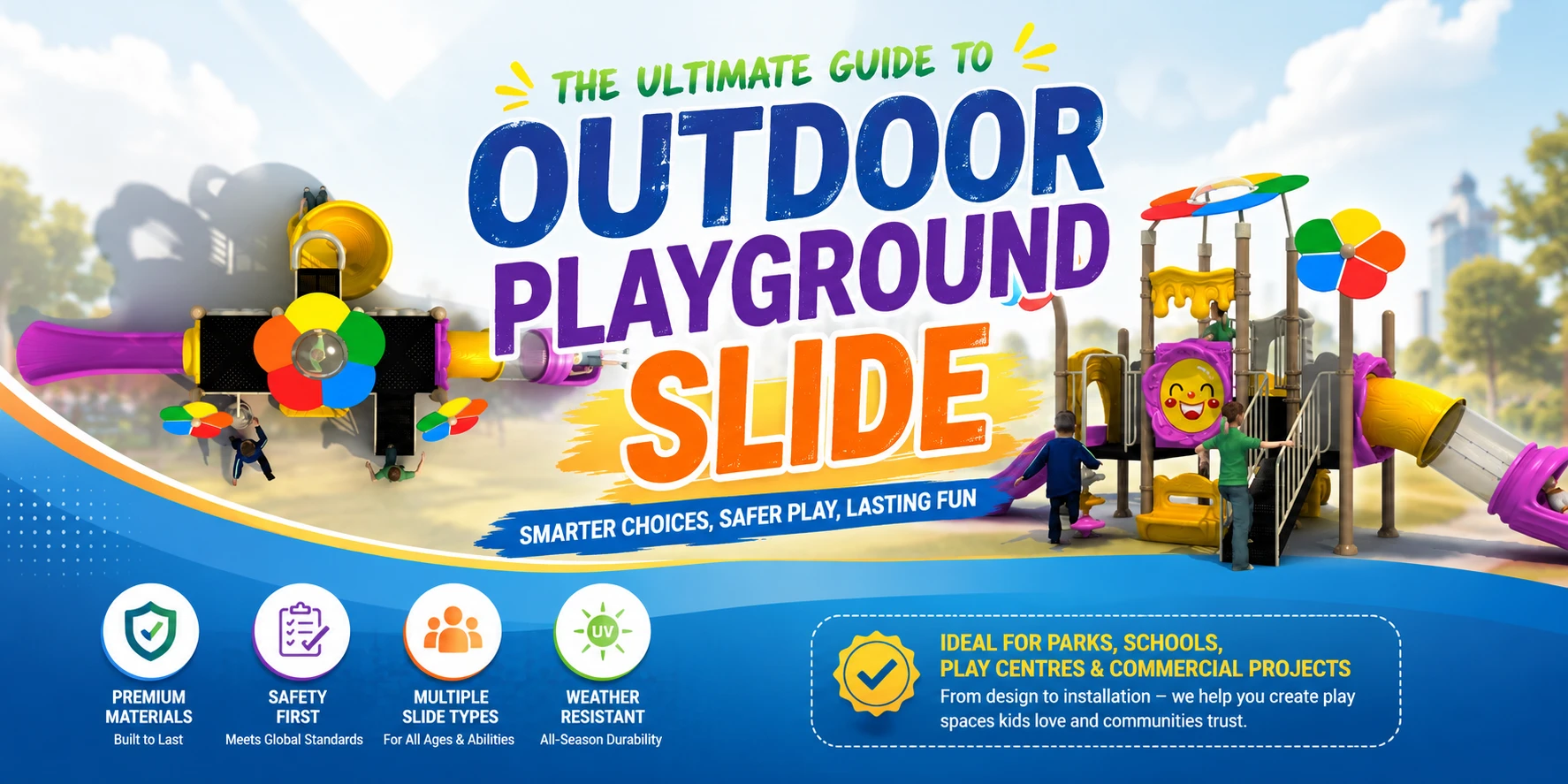
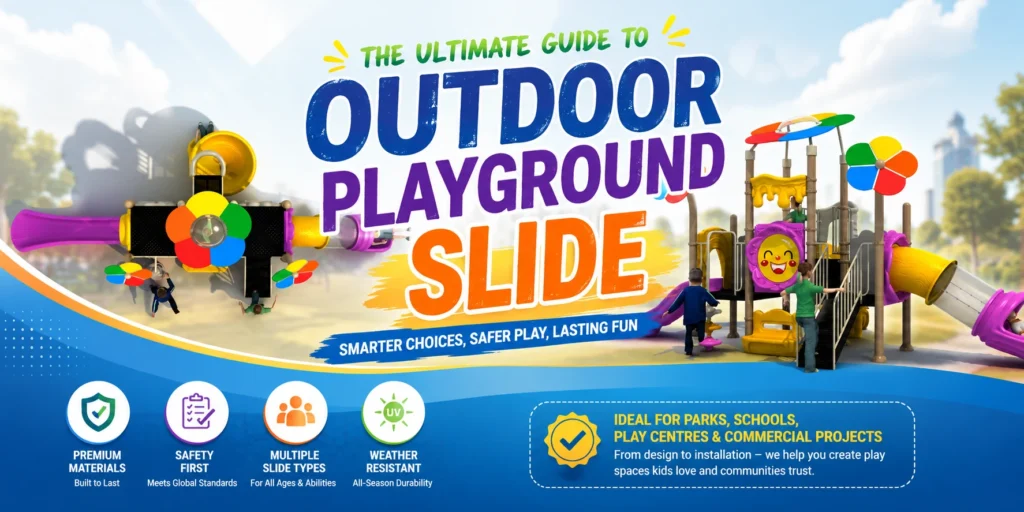
Buyers sourcing outdoor playground slides for commercial projects quickly realise the choice goes far beyond picking a colour. You must evaluate slide type, material durability, safety compliance, and supplier reliability before placing an order.
An outdoor playground slide designed for commercial use is a slide built from weather-resistant materials such as PE board or stainless steel, intended for high-traffic environments like parks, schools, and play centres. These structures must withstand constant use, UV exposure, and temperature swings without degrading.
This guide covers the main slide types you will encounter — spiral, wave, tube, and straight — and the selection criteria that matter most when comparing suppliers from manufacturing hubs like Wenzhou playground equipment clusters. Understanding these factors helps you source equipment that meets safety standards and lasts for years.
Understanding Outdoor Playground Slide Types for Commercial Playgrounds
Commercial slides are not one-size-fits-all. The five main configurations — straight, wave, spiral, tube, and combination units — each serve different play values, height limits, and age groups. Understanding these differences helps you match slide type to your project site and user profile.
- Straight slides: The simplest design, typically 1.2 to 3 metres high. Suitable for ages 2 to 8. Used on low platforms and as exit routes for smaller structures.
- Wave slides: A straight slide with two or three undulations. Height ranges 1.5 to 2.5 metres. Ideal for ages 3 to 10. The bumps add sensory feedback, making them popular in inclusive play areas and sensory gardens.
- Spiral slides: Wraps around a central pole for a compact footprint. Heights from 2 to 4 metres. Suited for ages 5 to 12. Often found on medium towers where space is constrained.
- Tube slides: Fully enclosed tunnel, usually in polyethylene. Heights from 2 to 6 metres. Best for ages 5 to 12, and for tall structures where visibility and containment improve safety. The tube reduces fall risk and shields users from sun heat.
- Combination slides: Two or more slide types joined on one platform — for example, a straight slide alongside a wave slide. This caters to mixed-age groups and increases capacity without expanding the deck footprint.
For commercial playgrounds in parks, schools, or play centres, tube slides are the default choice for structures over 3 metres high because they minimise fall clearance requirements and provide shade in hot climates. Wave slides, meanwhile, dominate sensory-rich installations common in inclusive playgrounds. When sourcing from outdoor playground equipment Wenzhou suppliers, you will often find these standardised heights and age recommendations built into product catalogues.
Key Factors to Evaluate When Sourcing Outdoor Playground Slides
Start with material quality, because it determines how long a slide survives in a public park or school playground. For commercial outdoor slides, the three dominant materials are rotomoulded PE board, stainless steel, and HDPE sheeting. PE board (polyethylene) resists UV degradation for 10–15 years and accepts custom colours throughout the mould. Stainless steel slides handle extreme traffic but absorb more heat in direct sun – surface temperatures can exceed 60°C on a 35°C day, so they require shaded placement or a covered start section. HDPE is an alternative for flat-bed slides and curved sections, often 12–19 mm thick, and it offers good impact resistance.
Safety standards are non-negotiable. In Europe, EN1176 specifies maximum free height of fall at 3 metres for slides over 1.5 m high, while ASTM F1487 governs the US market. Both standards set minimum head clearance (at least 1.5 m around the slide exit) and ban gaps that could trap clothing. For high-traffic installations – for example, a municipal playground serving 500+ children daily – look for a slide with reinforced landing zones and a guaranteed wall thickness of at least 5 mm if rotomoulded.
Slide height and speed directly affect age suitability. A straight slide up to 2.5 m suits children aged 5–12; taller structures (over 3 m) often use tube slides to reduce fall risk and add sun protection. Typical slide angles run 30–35 degrees, producing an exit speed of roughly 2–3 m/s – too steep and you risk over-rotation in younger users. Sourcing from an outdoor playground equipment Wenzhou factory means you can often request speed-calculated slope adjustments before tooling begins.
Durability for high-traffic use requires UV-stabilised colourants (pigment loading >8% to avoid fading within 2–3 years) and rust-proof fixtures. Stainless steel 304 or 316 is preferred for coastal or wet climates. Weather resistance also depends on the slide’s drainage design – check for moulded drain holes at low points to prevent water pooling.
Ease of installation varies by material. Pre-assembled modular PE board slides can go in over 2–3 days with a two-person crew, while stainless steel slides may require a crane and welding on site. Custom colours and modular designs are standard among large Wenzhou manufacturers; you can match slide colours to your park’s branding or to adjacent soft play equipment Wenzhou suppliers use for indoor zones. Always verify the slide’s bolt pattern and footing requirements against your site’s concrete substrate before ordering.
Comparing Materials: PE Board vs. Stainless Steel vs. Plastic for Durability and Safety
| Material | UV Resistance | Heat Absorption | Slip Resistance | Typical Lifespan | Relative Cost |
|---|---|---|---|---|---|
| PE board (rotomoulded) | High – UV stabilisers added during moulding | Low – stays cooler in direct sun | Good – textured surface when moulded | 8–12 years in commercial use | Medium |
| Stainless steel (304/316 grade) | Excellent – won’t fade or chalk | High – surface can exceed 60°C in summer | Poor when wet – requires tread pattern or coating | 15–20 years | High |
| Injection-moulded plastic (PP/HDPE) | Moderate – fades after 2–3 years | Moderate – warms but less than steel | Fair – smooth surface, can be slippery when wet | 3–6 years | Low |
PE board (rotomoulded polyethylene) dominates Wenzhou factory catalogues for a reason. The material absorbs less heat than stainless steel, so slide surfaces stay usable even in midday sun — surface temperature tests show PE board runs 10–15 °C cooler than stainless steel under identical conditions. UV stabilisers are compounded into the resin during moulding, not sprayed on later, which prevents the fading and chalking common on cheaper injection-moulded plastic after two seasons outdoors.
Stainless steel slides offer the longest service life — 15–20 years with proper maintenance — but the trade-offs matter for safety. Bare steel can reach surface temperatures above 60 °C in direct sunlight, making it unsuitable for uncovered installations in hot climates unless shaded. Slip resistance is another concern: polished stainless steel offers low friction when wet, so many commercial suppliers add embossed tread patterns or powder-coated sections to improve grip.
Injection-moulded plastic is the lightest option and the cheapest upfront, but it loses points on durability. Thin wall sections (typically 2–4 mm versus 5–8 mm for rotomoulded PE) are prone to cracking under repeated impact, and colour fading appears within 2–3 years in high-UV climates. For high-traffic commercial sites — schools, park playgrounds, soft play centres — PE board remains the practical middle ground: durable enough for daily use, cooler to touch, and available in the full colour range Wenzhou water playground equipment suppliers already stock for modular installations.
Frequently Asked Questions About Outdoor Playground Slides for Commercial Use
The following answers focus on practical specifications for commercial installations, from kindergarten playground equipment to public park structures.
What slide dimensions suit different age groups? For children aged 2–5, slide height should be 1–1.5 m with a slide width of 50–60 cm. Ages 5–12 can use slides 1.5–2.5 m high, with width 60–90 cm. Commercial playgrounds often install a mix of sizes to serve both toddler and older children zones.
What slope angle is recommended? Safety standards (EN 1176) typically allow slopes between 30° and 40°. Steeper angles above 40° increase exit speed beyond safe limits for general use. For wave slides, a gentler average slope of 28–32° is used to control speed while still providing sensory variation.
What are the installation requirements? Freestanding slides must be secured with concrete footings at least 300 mm deep in frost-free zones. A minimum fall zone of 1.8 m is required around the slide exit and sides for slides up to 2 m high. Use a level, compacted base of 100 mm clean gravel beneath the impact surface.
How should commercial slides be maintained? Inspect monthly for cracks, loose fixings, and surface wear. Clean with mild detergent and water; avoid abrasive cleaners on PE board surfaces. Apply UV stabiliser spray annually to playground facility equipment exposed to direct sun in high-UV climates.
What is the typical lifespan? PE board slides last 10–15 years in commercial settings with regular maintenance. Stainless steel can exceed 20 years but may become too hot in direct sun. Injection-moulded plastic lasts 5–8 years before colour fading and brittleness appear.
How much space is needed per slide? Allow a minimum of 3 m of clear space in front of the slide exit (landing zone) and 1.5 m on each side for deck-mounted slides. For spiral or tube designs, add an extra 1 m radius to account for turning clearance.
About JQ Playground – wenzhouplaygroundequipment.com
JQ Playground (Wenzhou Jiqi Amusement Equipment Co., Ltd.) is a children’s playground equipment manufacturer founded in 1993. The company provides design, customization, large-scale manufacturing, sales, installation guidance, and after-sales support for outdoor playgrounds, indoor playgrounds, soft play, water playgrounds, PE board playgrounds, kindergarten furniture, outdoor fitness equipment, pet playgrounds, and playground facilities. Approved company facts include 180+ employees, a large Wenzhou production base, 20+ production lines, 55 production machines, ISO/BSCI/EN1176/EN71/ASTM/CPC/CPSIC certification references, 100+ patents, free design support, OEM/ODM capability, trial installation before shipping, export experience, and one-year quality warranty.